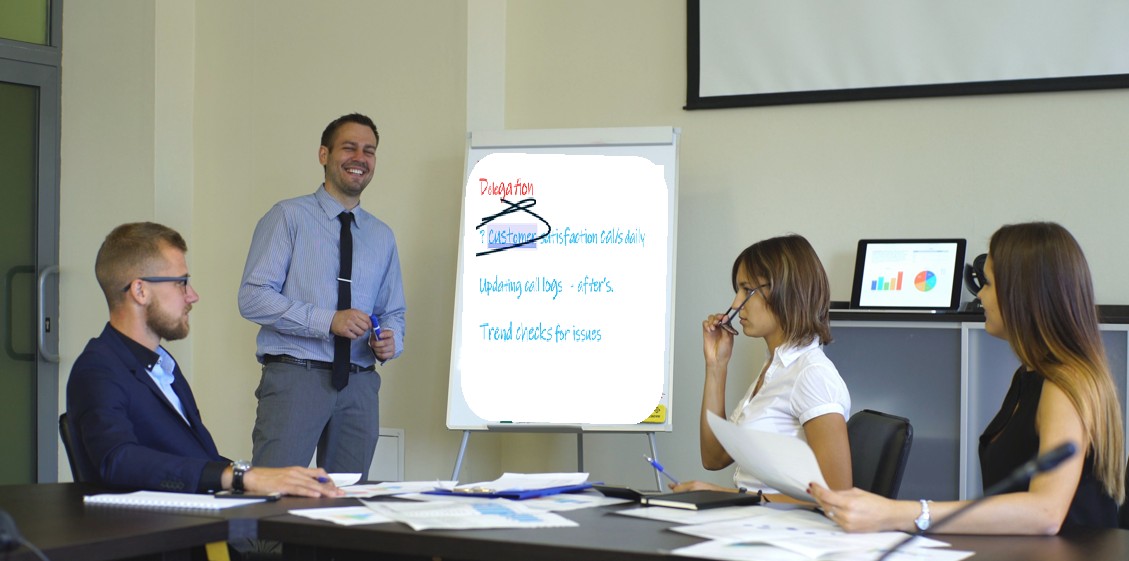
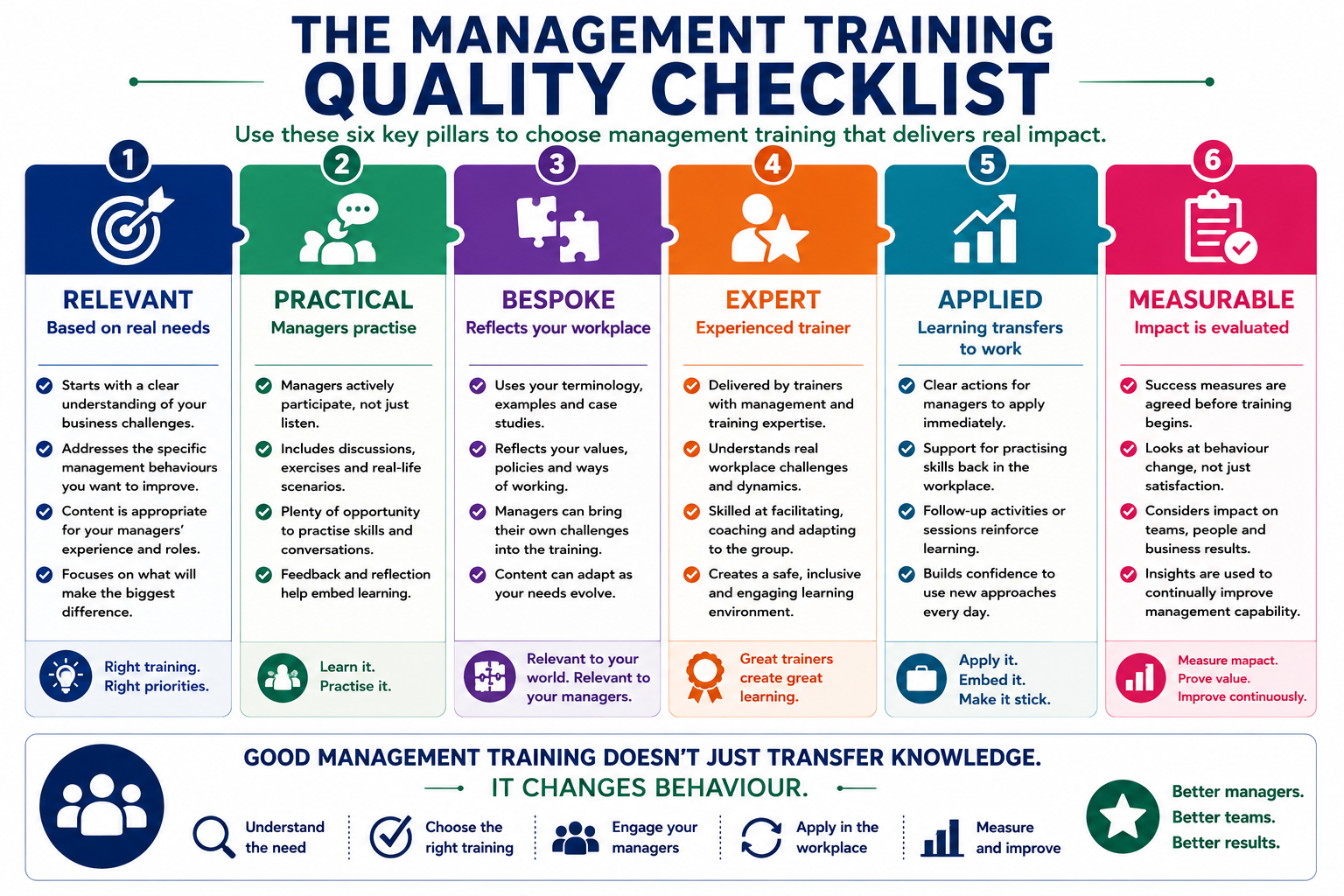
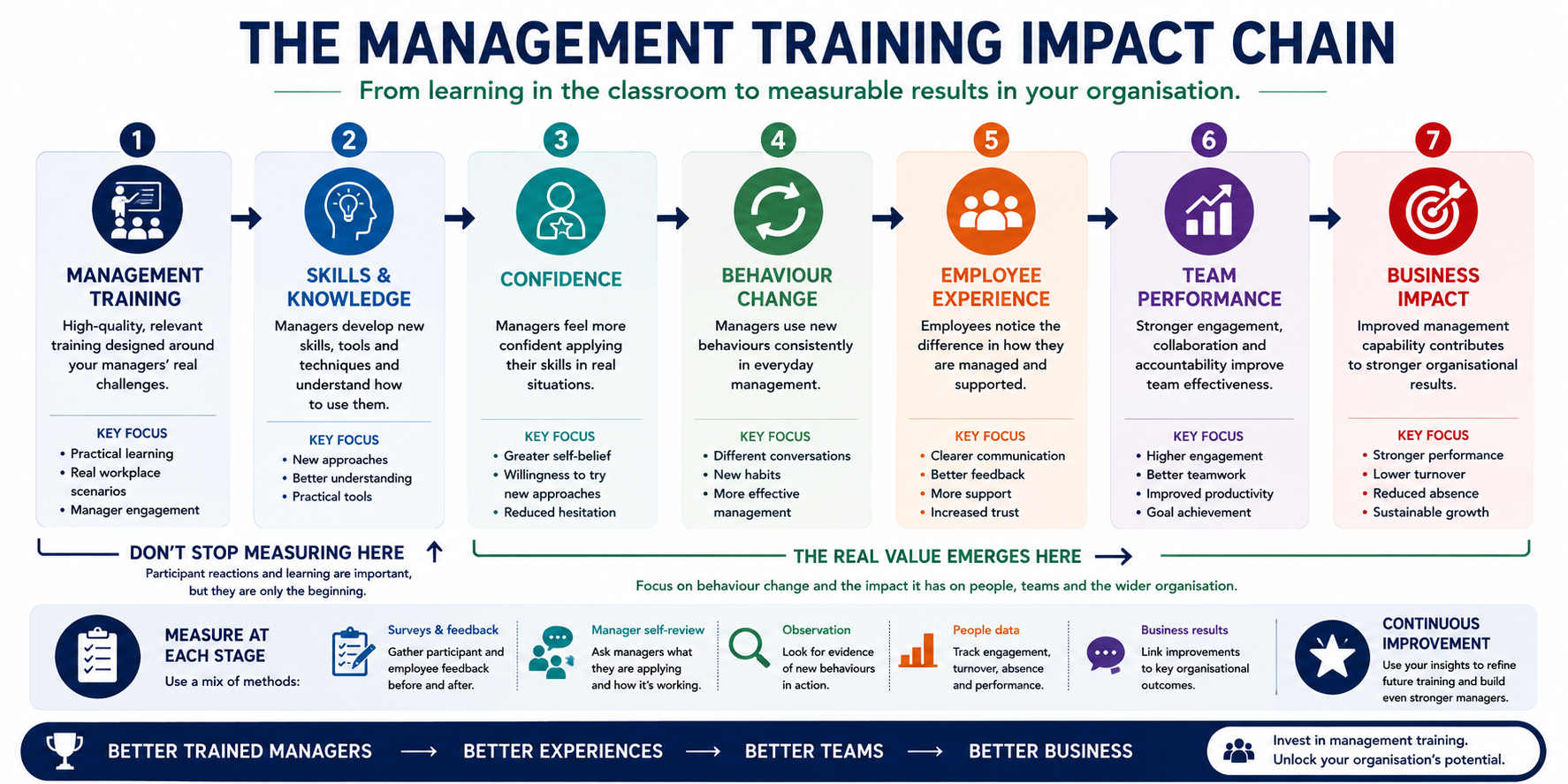
Key Takeaways of this Best Practice Guide
- Management training equips managers with the practical skills needed to lead people, communicate effectively, make sound decisions and improve team performance.
- Effective managers are developed through experience, feedback and structured learning rather than being born with natural leadership ability.
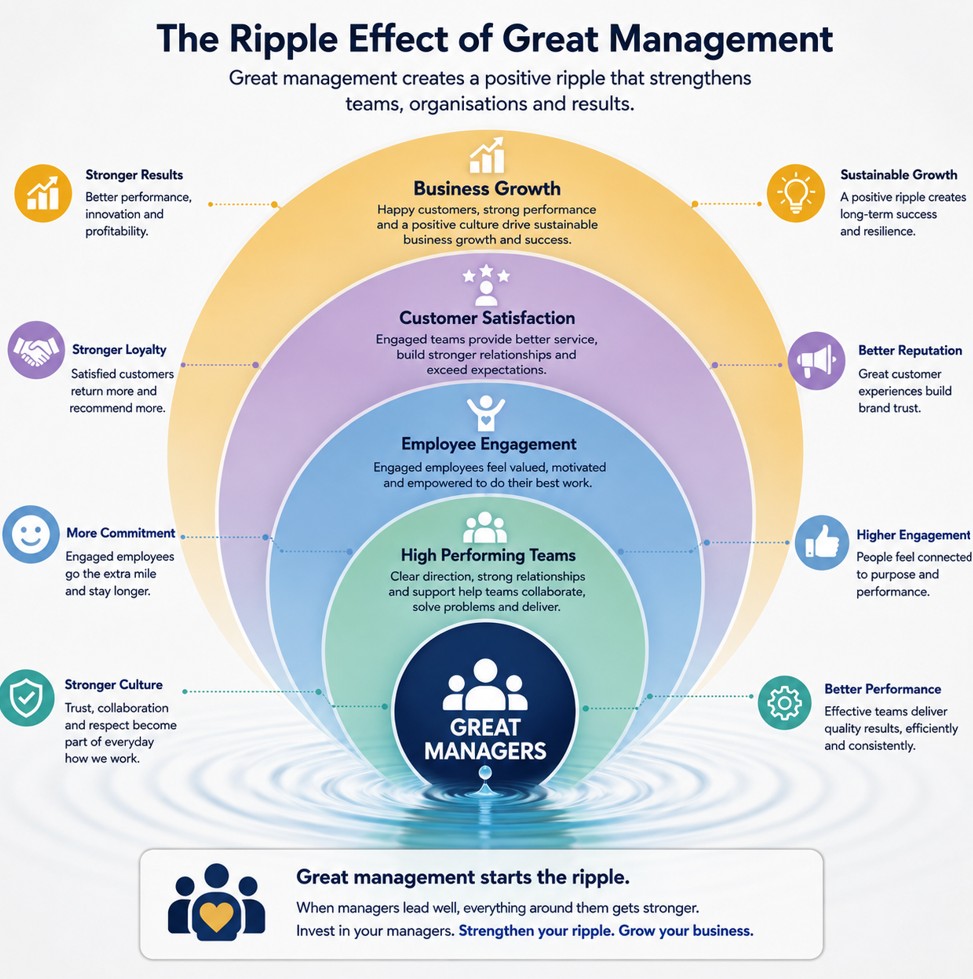
- Organisations that invest in management development often benefit from higher employee engagement, stronger retention, better productivity and improved organisational performance.
- Modern management extends beyond supervising work. Today's managers are expected to coach, support wellbeing, navigate change, build inclusive teams and lead through uncertainty.
- The most effective management programmes combine practical workshops, real workplace scenarios, coaching and opportunities to apply new skills back in the workplace.
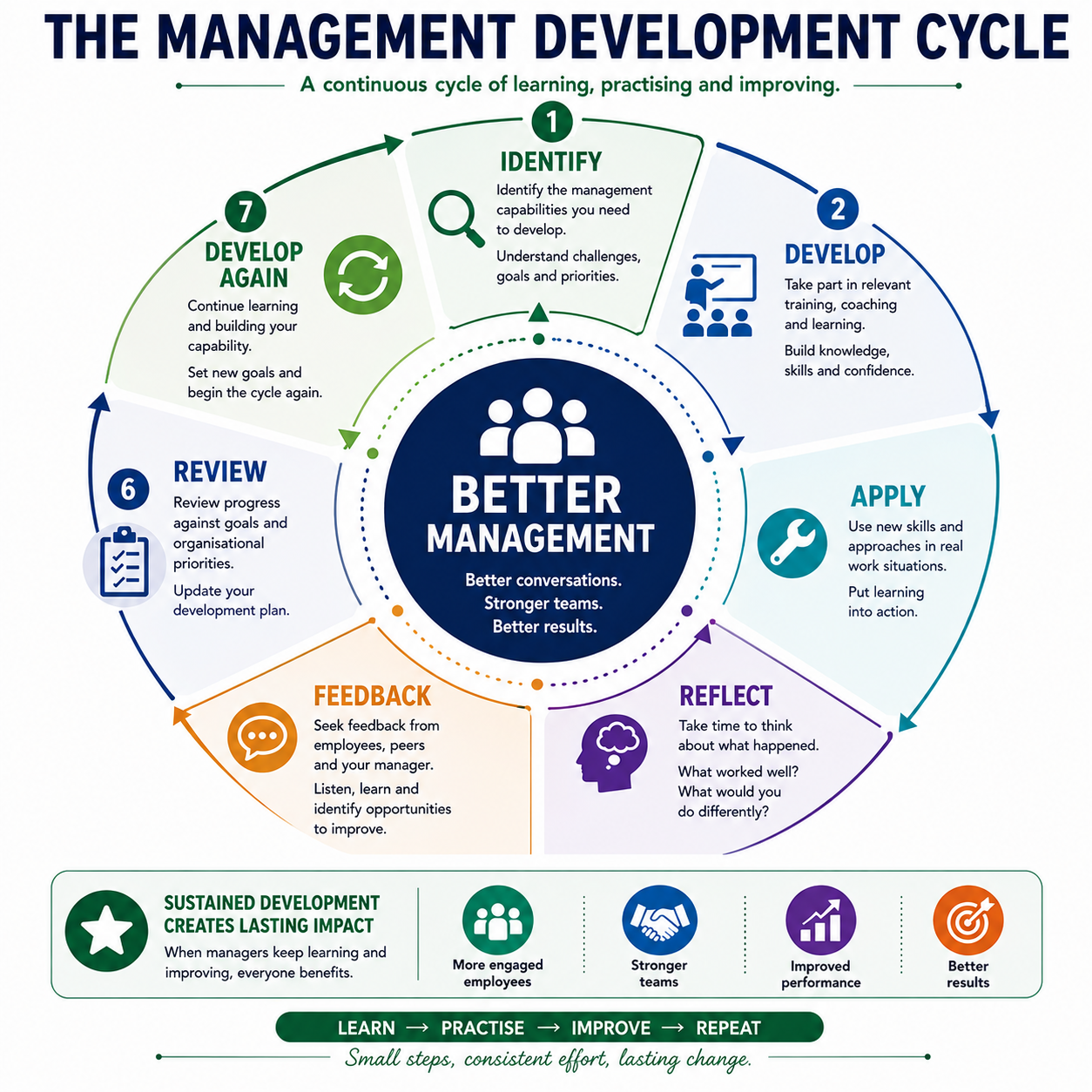
- Management development should not be a one-off event. Ongoing learning helps managers adapt to changing business needs and continue developing throughout their careers.
Introduction
Across the South West, organisations of every size depend on capable managers to lead their people effectively. From growing businesses in Somerset and Dorset to manufacturers, professional services firms, charities and hospitality organisations across Devon and Cornwall, managers often face the same challenge: they may have considerable technical expertise but little formal preparation for managing people. Developing practical management skills can help organisations across the region build stronger teams, retain talented employees and create a pipeline of confident future leaders.
Whether a business employs ten people or ten thousand, the quality of its managers has a direct influence on employee engagement, productivity, customer satisfaction and long-term success. Managers are the link between organisational strategy and day-to-day operations. They translate business objectives into practical action, provide direction, solve problems, support employees and create the conditions that allow teams to perform at their best.
Despite this responsibility, many managers receive little formal preparation before stepping into their role. High-performing employees are frequently promoted because of their technical expertise or professional knowledge, yet the skills that make someone an excellent engineer, salesperson, administrator or technician are rarely the same skills required to manage people effectively.
Managing people is fundamentally different from completing individual tasks. It requires the ability to communicate clearly, build trust, delegate responsibility, motivate others, provide constructive feedback, resolve conflict and make balanced decisions. These capabilities are developed through experience, reflection and structured learning—not simply through promotion or years of service.
The workplace itself has also changed dramatically. Hybrid working, rapid technological advances, increased expectations around employee wellbeing, greater cultural diversity and the growing influence of artificial intelligence mean that managers face more complex challenges than ever before. Today's managers are expected to be coaches, communicators, problem-solvers and change leaders while continuing to deliver operational results.
For organisations, investing in management training is no longer simply about improving leadership capability. It is about strengthening organisational performance, retaining talented employees, reducing costly management mistakes and creating workplaces where people feel supported, motivated and able to contribute.
For individuals, management training provides the confidence and practical skills needed to navigate difficult situations, develop stronger working relationships and become more effective leaders. It helps new managers make a successful transition into leadership while enabling experienced managers to refine their approach and adapt to new challenges.
This guide explores every aspect of management training, from understanding its purpose and value through to identifying development needs, choosing the right training approach and measuring success. Whether you are an employer planning a management development programme, an HR professional responsible for learning and development, or a manager looking to strengthen your own capabilities, this guide provides practical insights and evidence-based best practice to help you develop confident, capable and successful managers.
Contents
- What is Management Training?
- Why Management Training Matters
- The Changing Role of the Modern Manager
- The Essential Skills Every Manager Needs
- Common Management Challenges
- Different Types of Management Training
- Identifying Management Training Needs
- Choosing the Right Management Training Programme
- Measuring the Success of Management Training
- Frequently Asked Questions
- Management Resources and Further Reading
Chapter 1. What is Management Training?
"Good management doesn't happen by chance. It develops through knowledge, experience, reflection and continuous learning."
Helen Juke, Avantis Consulting
Management training is the structured process of developing the knowledge, skills and behaviours needed to lead people effectively. While many people become managers because they excel in their technical role, managing people requires an entirely different set of capabilities. The ability to deliver excellent sales results, solve engineering problems or manage complex projects does not automatically prepare someone to motivate a team, navigate difficult conversations or build a positive working culture.
At its core, management training equips individuals with the practical tools needed to help others succeed. It develops confidence in leading people, improves communication, strengthens decision-making and provides managers with frameworks for handling the many situations they encounter throughout their careers.
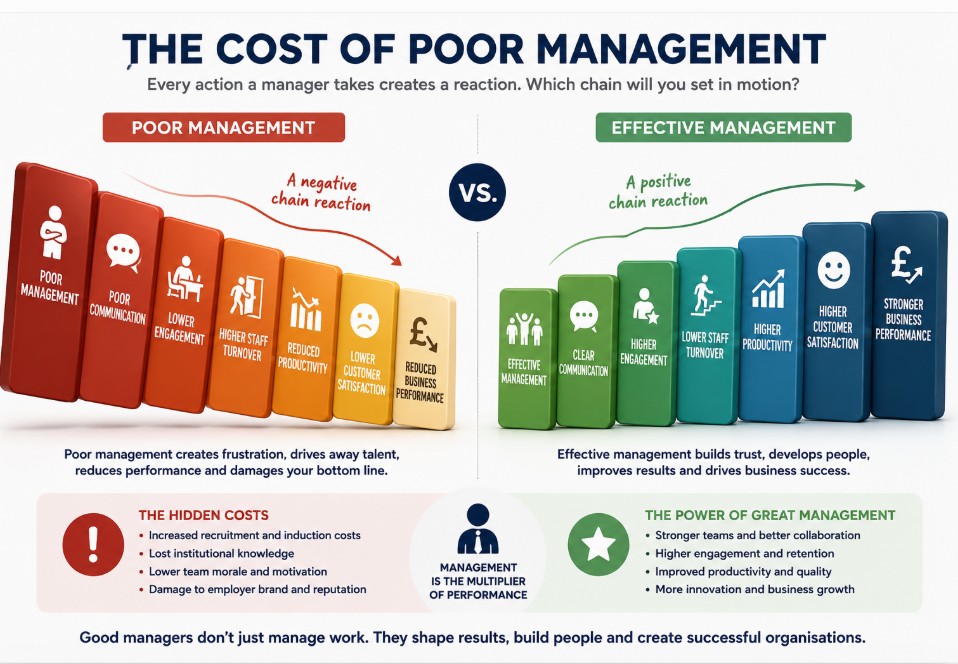
For organisations, management training is an investment in people and performance. Effective managers influence almost every aspect of organisational success. They shape employee engagement, encourage innovation, resolve conflict, manage change and create environments where individuals can perform at their best. Conversely, poor management often results in low morale, increased staff turnover, inconsistent performance and reduced productivity.
Management training is therefore about much more than learning policies or understanding procedures. It is about developing judgement, emotional intelligence and the confidence to make balanced decisions while supporting the needs of both the organisation and its people.
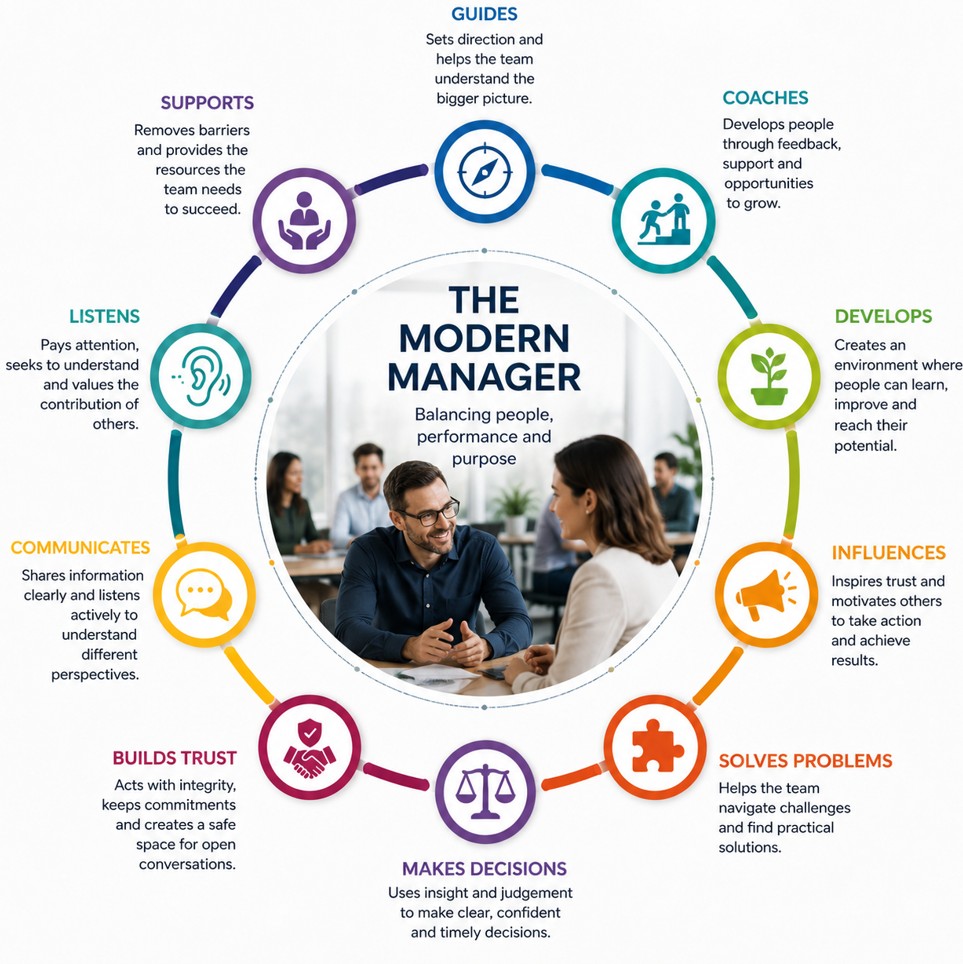
One of the most common misconceptions is that management is simply about supervising work. Modern managers spend much of their time coaching employees, removing barriers, facilitating collaboration and helping people grow professionally. Rather than directing every activity, successful managers create the conditions that allow others to succeed.
Another misconception is that great managers are born rather than developed. While some individuals naturally possess qualities such as confidence or empathy, research and experience consistently demonstrate that effective management behaviours can be learned. Skills such as active listening, delegation, giving feedback, coaching, influencing and conflict resolution improve through structured learning, deliberate practice and ongoing reflection.
The demands placed on managers have also evolved significantly. Today's workplaces are more diverse, more technologically connected and often more geographically dispersed than ever before. Hybrid working, artificial intelligence, rapid organisational change and growing expectations around employee wellbeing require managers to adapt continuously. As a result, management development is no longer a one-off training course completed after promotion. It is an ongoing process of learning, applying new approaches and refining leadership capabilities throughout a manager's career.
Whether someone is preparing for their first supervisory role or leading a large department, management training provides the foundation upon which confident, capable and successful managers are built.
Did you Know?
The average employee experiences management every single working day. A manager's communication style, decision-making, feedback and leadership influence not only productivity but also employee engagement, confidence and workplace wellbeing. For many people, their manager has a greater day-to-day impact on their work experience than the organisation's senior leadership team.
Sarah's Promotion - A Growing Dorset Business in Bournemouth
Sarah had been the highest-performing member of her Dorset based customer service team for three consecutive years. When the team leader position became available, promoting her seemed like the obvious choice.
Within a few months, however, performance had begun to decline. Sarah struggled to delegate because she believed it was quicker to complete tasks herself. She found performance conversations uncomfortable, avoided addressing issues early and spent most of her day solving problems that her team could have resolved independently.
After completing a structured management development programme with Training South West, Sarah adopted a different approach. She introduced regular one-to-one meetings, learned how to coach rather than direct, delegated responsibility more effectively and became more confident giving constructive feedback. Within six months, employee engagement improved, team productivity increased and Sarah reported feeling far less overwhelmed.
The technical expertise that earned Sarah her promotion remained valuable, but it was her management skills that enabled her team to succeed.
Quick Facts
Management Training Helps Managers...
|
|---|
- Communicate more effectively
|
- Build trust within their teams
|
|
- Coach employees to improve performance
|
- Handle difficult conversations professionally
|
- Resolve workplace conflict constructively
|
- Lead organisational change
|
- Make balanced, informed decisions
|
- Improve employee engagement
|
|
Common Misconceptions
| Myth |
Reality |
| Great managers are born. |
Great managers continually learn and develop. |
| Management is about telling people what to do. | Modern management focuses on coaching, support and enabling performance. |
| Technical expertise automatically creates good managers. | Managing people requires a completely different set of skills |
| Training is only necessary for new managers. | Experienced managers also benefit from continuous development as workplaces evolve. |
Manager's Takeaway
Management is not about having all the answers. It is about creating an environment where other people can perform at their best. The most effective managers spend less time controlling work and more time developing the people who do it.
Chapter 2: Why Management Training Matters
"People may join an organisation because of its reputation or opportunities, but their day-to-day experience is largely shaped by the quality of their manager."
Neil Payne, Commisceo Global Consulting
Every organisation depends on effective management. Whether leading a small team of five or overseeing hundreds of employees across multiple departments, managers influence how people communicate, collaborate, solve problems and perform. Their decisions affect not only operational outcomes but also workplace culture, employee engagement and the overall success of the organisation.
For this reason, management training should never be viewed simply as another learning initiative. It is an investment in the people responsible for bringing strategy to life. While senior leaders define organisational goals, it is managers who translate those goals into everyday action. They allocate work, support employees, manage performance, resolve issues and create the environment in which people either thrive or struggle.
The impact of management extends far beyond productivity alone. A skilled manager helps people understand expectations, builds confidence through constructive feedback, encourages innovation by creating psychological safety and develops individuals to reach their full potential. Employees who feel supported are generally more motivated, more engaged and more willing to contribute ideas that improve the organisation.
Poor management has the opposite effect. Unclear communication, inconsistent decision-making, lack of recognition and unresolved conflict often create frustration and uncertainty. Over time this can reduce morale, increase absenteeism, encourage talented employees to seek opportunities elsewhere and ultimately affect customer experience and business performance.
Management training helps organisations avoid these challenges by equipping managers with the practical skills needed to lead people effectively. Rather than relying on instinct or learning through trial and error, trained managers develop proven approaches for motivating teams, handling difficult situations and making balanced decisions.
Importantly, management development also supports consistency. Employees expect fairness, clarity and professionalism regardless of which manager they report to. A structured management development programme helps create shared standards and common approaches across the organisation, strengthening both employee experience and organisational culture.
As workplaces continue to evolve, the importance of effective management continues to grow. Hybrid working, technological change, increasing diversity and rising expectations around wellbeing require managers to demonstrate adaptability, empathy and strong communication skills. Investing in management capability is therefore not simply about preparing managers for today's challenges—it is about equipping organisations for the future.
The Business Benefits of Management Training
Rather than focusing solely on individual managers, organisations increasingly recognise that management development delivers measurable business benefits.
a) Improved Employee Engagement Employees are more likely to feel motivated when they understand what is expected of them, receive regular feedback and believe their manager genuinely supports their development.
Good managers create environments where people feel valued, listened to and trusted. This sense of belonging often leads to higher engagement, greater discretionary effort and stronger commitment to organisational goals.
b) Higher Productivity Productive teams rarely happen by accident.
Managers influence productivity by setting clear priorities, removing obstacles, delegating effectively and helping employees focus on work that delivers the greatest value.
When managers communicate expectations clearly and provide timely support, individuals spend less time dealing with uncertainty and more time achieving meaningful results.
c) Better Employee Retention Replacing employees is expensive.
Recruitment costs, onboarding time, lost productivity and the impact on team morale all contribute to the true cost of turnover.
Managers who build positive relationships, recognise achievement and support career development help create workplaces where people choose to stay.
d) Stronger Communication Communication sits at the heart of effective management.
Management training helps leaders develop active listening skills, adapt their communication style, provide constructive feedback and manage difficult conversations with greater confidence.
Improved communication reduces misunderstandings, strengthens collaboration and builds trust throughout the organisation.
e) Improved Decision Making Managers make dozens of decisions every day.
Some are operational.
Others affect people, priorities and organisational direction.
Management development equips leaders with practical frameworks for analysing situations, considering different perspectives and making balanced, informed decisions under pressure.
f) Greater Adaptability During Change Every organisation experiences change.
Whether introducing new technology, restructuring teams or responding to market conditions, managers play a crucial role in helping employees understand and embrace change.
Training gives managers the confidence to communicate openly, address concerns and maintain engagement during periods of uncertainty.
Did you know?
Employees often judge an organisation by the quality of their immediate manager rather than its senior leadership team.
While organisational strategy is developed at executive level, most employees experience their workplace through daily interactions with their line manager. This makes management capability one of the strongest influences on workplace culture and employee experience.
Real Workplace Scenario: Managing a Hybrid Team in Plymouth, Devon
Introducing a New Management Programme
A growing manufacturing company in Exeter had promoted several experienced engineers into supervisory positions as the business expanded. Although technically excellent, many of the new managers found it difficult to delegate work, provide feedback or manage performance issues.
Within twelve months the organisation experienced increasing staff turnover, inconsistent communication between departments and declining employee engagement.
The company introduced a structured management development programme covering communication, delegation, coaching, conflict resolution and performance management. Managers also received practical opportunities to apply new techniques between workshops.
Six months later, managers reported greater confidence in leading their teams, employee feedback became more positive and collaboration between departments had noticeably improved. Productivity increased—not because employees worked longer hours, but because expectations were clearer, communication improved and managers spent less time solving avoidable problems.
Quick Facts
Organisations that invest in management development often experience:
✔ Higher employee engagement
✔ Better communication
✔ Stronger collaboration
✔ Improved productivity
✔ Reduced staff turnover
✔ Greater innovation
✔ Better customer experience
✔ More confident managers
✔ Stronger organisational culture
✔ Improved business performance
Manager's Takeaway
Organisations that invest in management development often experience:
✔ Higher employee engagement
✔ Better communication
✔ Stronger collaboration
✔ Improved productivity
✔ Reduced staff turnover
✔ Greater innovation
✔ Better customer experience
✔ More confident managers
✔ Stronger organisational culture
✔ Improved business performance
Chapter 3: The Changing Role of the Modern Manager
"Twenty years ago, managers were expected to supervise work. Today, they are expected to develop people, navigate change and create environments where teams can thrive."
Natalie Salem, Management Training, Training South West
The role of a manager has changed dramatically over the past two decades. While planning work, allocating resources and monitoring performance remain important responsibilities, modern management is no longer centred on controlling people or directing every task. Today's managers are expected to lead through influence rather than authority, creating workplaces where employees feel trusted, motivated and able to contribute their best work.
This shift has been driven by profound changes in the way organisations operate. Hybrid working has transformed how teams communicate and collaborate. Advances in technology and artificial intelligence have automated many routine tasks, placing greater emphasis on creativity, judgement and relationship-building. At the same time, employees increasingly expect managers to provide meaningful feedback, support professional development and promote wellbeing alongside business performance.
As a result, management has become significantly more people-focused. Modern managers still deliver results, but they achieve those results by enabling others rather than controlling them. Success is measured not simply by operational performance but by the strength of the team, the quality of relationships and the ability to adapt in an increasingly complex business environment.
The most effective managers recognise that every interaction matters. A five-minute conversation can build confidence, clarify expectations, encourage innovation or strengthen trust. Equally, poor communication or inconsistent behaviour can quickly undermine engagement and damage relationships. For this reason, management is no longer viewed as a position of authority alone—it is a continuous practice of communication, coaching and leadership.
Organisations are also operating in environments characterised by constant change. New technologies emerge rapidly, customer expectations evolve, markets shift and employees work across different locations, cultures and time zones. Managers must therefore be comfortable leading through uncertainty, helping their teams remain focused while adapting to new ways of working.
Perhaps the biggest change of all is the growing expectation that managers develop people rather than simply manage performance. Employees increasingly value opportunities to learn, grow and contribute. Great managers understand that their role is not to have all the answers but to create an environment where others can succeed.
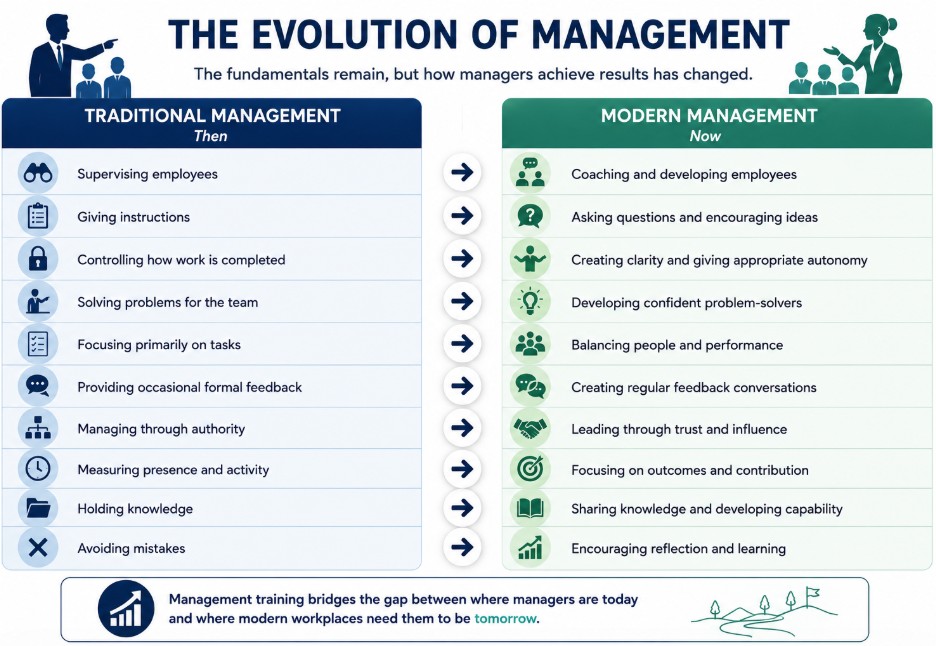
The Evolution of Management
The fundamentals of management have not disappeared, but the way managers achieve results has changed considerably. Traditional management often placed greater emphasis on supervision, hierarchy and control. Managers allocated tasks, monitored activity and were frequently expected to provide the answers when problems arose.
Modern management is more collaborative. Employees are increasingly expected to take ownership, contribute ideas, solve problems and make decisions within their areas of responsibility. The manager's role is therefore shifting from simply directing work to creating the conditions in which people can perform successfully.
| Traditional Approach |
Modern Management Approach |
| Supervising employees |
Coaching and developing employees |
| Giving instructions | Asking questions and encouraging ideas |
| Controlling how work is completed | Creating clarity and giving appropriate autonomy |
| Solving problems for the team | Developing confident problem-solvers |
| Focusing primarily on tasks | Balancing people and performance |
| Providing occasional formal feedback | Creating regular feedback conversations |
| Managing through authority | Leading through trust and influence |
| Measuring presence and activity | Focusing on outcomes and contribution |
| Holding knowledge | Sharing knowledge and developing capability |
| Avoiding mistakes | Encouraging reflection and learning |
This evolution has important implications for management training. Managers need opportunities to develop and practise a much broader range of skills than may have been expected of previous generations of managers.
How Management Training is Changing
As the role of the manager evolves, management training must evolve with it.
Traditional management training often concentrated heavily on processes: setting objectives, planning workloads, monitoring performance and understanding organisational procedures. These remain important, but they are no longer enough on their own.
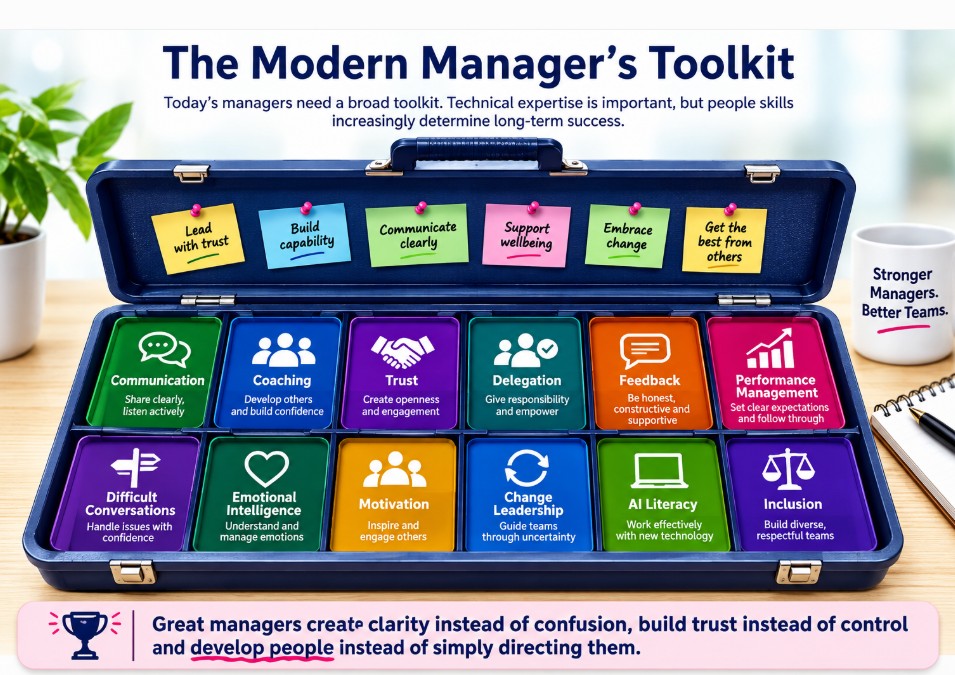
Today's management training programmes increasingly focus on the human skills required to get the best from people. Managers need to know how to listen, coach, delegate, motivate, give feedback, manage conflict, hold difficult conversations and create trust. They also need the confidence to lead people through uncertainty and change.
Effective management training therefore moves beyond theory. Managers need opportunities to discuss genuine workplace challenges, practise conversations, explore different approaches and receive feedback. This helps them translate knowledge into behaviour they can use when they return to the workplace.
For first-time managers in particular, this practical approach can be invaluable. Moving from being responsible primarily for your own work to being responsible for the performance and development of other people represents a significant professional transition. First-time manager training can provide the tools, frameworks and confidence needed to make that transition successfully.
Experienced managers also need continued development. Hybrid working, multigenerational teams, artificial intelligence, changing employee expectations and increasingly diverse workplaces mean that management practices that worked ten years ago may not always be appropriate today.
Management development should therefore be viewed as an ongoing process rather than a course that someone completes once at the beginning of their management career.
Six Key Expectations of the Modern Manager
1. Coach Rather Than Simply Direct
One of the biggest changes in modern management is the movement from telling people what to do towards helping them think for themselves.
When employees approach a manager with a problem, the quickest response may be to provide the answer. However, continually doing so can create dependency. Coaching involves asking questions, exploring options and helping employees develop their own solutions.
Over time, this builds confidence, capability and greater ownership within the team.
Management training can help managers develop coaching techniques and practise asking effective questions rather than immediately offering solutions. This is particularly valuable for technically experienced managers who are accustomed to being the person others turn to for answers.
2. Build Trust Rather Than Rely on Authority
A management title may give someone formal authority, but it does not automatically create trust.
Trust develops through behaviour. Managers build it by communicating honestly, treating people fairly, keeping commitments, listening to concerns and being consistent in their decisions.
This becomes particularly important when employees have greater autonomy or work remotely. Managers cannot—and should not—observe everything their team does. They need to establish clear expectations and then trust people to deliver.
Management skills training can help managers recognise behaviours that strengthen or undermine trust and develop approaches that balance autonomy with appropriate accountability.
3. Communicate with Clarity
Communication has always been important to management, but today's working environment makes it even more critical.
Teams may be spread across offices, homes, sites and different working patterns. Employees are also managing large volumes of information through email, meetings, messaging platforms and other digital channels.
Modern managers need to decide not only what to communicate, but how, when and why.
Good communication creates clarity around priorities, responsibilities and expectations. It also gives employees opportunities to ask questions, raise concerns and contribute ideas.
For this reason, communication skills are usually a core component of effective management training programmes. Managers can learn how to adapt their communication style, listen actively, run more productive conversations and communicate clearly when situations are difficult or uncertain.
4. Develop People, Not Just Performance
Managing performance remains essential, but effective managers look beyond today's results.
They consider what their employees could become.
Regular one-to-one conversations, constructive feedback, coaching, delegation and development opportunities allow managers to build capability within their teams.
This benefits individuals, but it also benefits the organisation. Developing people creates greater internal capability, strengthens succession planning and reduces reliance on a small number of experienced employees.
Good management training therefore teaches managers how to move beyond simply identifying what went wrong and towards conversations that help employees understand how they can improve and develop.
5. Lead Through Change
Change is now a normal part of organisational life.
Businesses introduce new technologies, restructure teams, change systems, respond to economic pressures and adapt to changing customer expectations. Artificial intelligence is accelerating this further by changing how many everyday tasks are completed.
Managers often sit at the centre of these transitions.
They may not have made the decision to introduce a change, but they are frequently responsible for explaining it, responding to concerns and helping employees adapt.
Management development training can prepare managers for this responsibility by developing communication, resilience, emotional intelligence and change leadership skills. Rather than simply announcing what is changing, managers learn how to help people understand why change is happening and what it means for them.
6. Balance People and Performance
Perhaps the defining challenge of modern management is balancing the needs of people with the needs of the organisation.
Supporting employees does not mean avoiding accountability. Equally, delivering results should not mean ignoring wellbeing, development or working relationships.
Effective managers learn to do both.
They establish clear expectations, address performance problems when necessary and make difficult decisions, while also listening, supporting development and treating employees with respect.
This balance requires judgement, and judgement develops through experience, reflection and learning. This is one reason why effective management training uses realistic workplace scenarios rather than relying solely on theory.
Management in the South West: A Changing Workplace
These changes are just as relevant to managers working across the South West as they are to those in large national or international organisations.
Businesses across Somerset, Devon, Dorset and Cornwall operate in an increasingly complex environment. Managers may be leading employees across multiple sites, supervising hybrid teams, responding to skills shortages, introducing new technology or managing teams containing people with very different levels of experience.
The region also includes an extremely diverse mix of organisations, from manufacturing, engineering and professional services to tourism, hospitality, charities and growing owner-managed businesses. The precise challenges may differ, but the need for confident, capable managers remains consistent.
For many organisations, promoting an experienced employee into their first management role is a natural progression. However, professional or technical expertise does not automatically provide the people-management skills needed to lead a team. Providing structured management training for new and existing managers can help bridge that gap.
Real Workplace Scenario: From Technical Expert to People Manager in Taunton, Somerset
A successful engineering business in Somerset promoted one of its most experienced technical specialists into a management role. His knowledge of the business was exceptional and, whenever a member of his team encountered a problem, he could usually identify the solution quickly.
Initially, this seemed like a strength. However, as the team grew, employees became increasingly dependent on him. Decisions were regularly escalated to their manager, relatively minor problems waited for his input and he found himself working longer hours simply to keep everything moving.
The problem was not his technical expertise. It was that his role had changed.
During a management training programme, he explored the difference between being the expert and developing expertise in others. He practised coaching techniques, learned how to ask questions rather than immediately providing answers and identified opportunities to delegate greater responsibility to experienced members of his team.
Instead of responding to every problem with a solution, he began asking questions such as, "What options have you considered?", "What would you recommend?" and "What do you need from me to move this forward?"
Gradually, team members became more confident making decisions and solving problems independently. The manager had more time to focus on planning, development and longer-term priorities, while the team developed greater capability and ownership.
His technical knowledge remained valuable. What changed was how he used it.
The transition from expert to manager was not about knowing less—it was about learning when to step back so that other people could grow.
Inside a Manager Training Workshop
A practical exercise for this topic might ask managers to consider a familiar scenario:
An experienced employee asks, "What do you think I should do?"
Instead of immediately providing the answer, participants practise responding with coaching questions such as:
What options have you considered?
What do you think would work best?
What might be the risks of that approach?
What support would you need from me?
Managers can then reflect on when coaching is appropriate and when a situation genuinely requires clear direction.
Simple exercises like this allow participants to experience the difference between managing for dependency and managing for capability.
How Management Training Prepares Modern Managers
A well-designed management training programme should prepare managers for the realities of today's workplace rather than simply teaching management theory.
It should help managers to:
- communicate clearly and confidently;
- coach employees rather than automatically providing solutions;
- delegate responsibility effectively;
- establish trust while maintaining accountability;
- give constructive and meaningful feedback;
- manage performance confidently;
- navigate difficult conversations;
- lead teams through uncertainty and change;
- manage hybrid and flexible teams;
- develop emotional intelligence and self-awareness;
- make effective use of new technologies, including AI; and
- create environments where people can contribute, develop and perform.
Most importantly, management training should give managers opportunities to practise these skills.
Knowing the principles of a difficult conversation is very different from sitting opposite an employee and having one. Understanding delegation theoretically is different from deciding what to delegate, to whom and how much responsibility to give. Knowing that coaching is valuable is different from resisting the temptation to provide an immediate answer.
Practical management training creates a safe environment in which managers can explore these situations before they encounter them—or handle them again, in the workplace.
Manager's Takeaway
The modern manager is no longer defined by how closely they control the work of others. Effective managers create clarity, build trust, develop capability and enable people to take greater ownership. As workplaces continue to change, management training helps managers develop the practical skills and confidence needed to adapt with them.
Chapter 4: Essential Skills Developed Through Management Training
"The strongest managers never stop developing. Every conversation, challenge and decision is an opportunity to become better at leading people."
Giles Hemmingway, CEO and Speaker
Becoming an effective manager requires a broad combination of practical skills, behaviours and judgement. Managers need to communicate clearly, make decisions, manage performance and deliver results, but they also need to understand people. They must know when to provide direction and when to step back, when to listen and when to challenge, and how to balance the needs of individual employees with those of the wider organisation.
Few people arrive in management already confident in all of these areas.
This is one of the reasons management training is so important. A well-designed management training programme gives managers the opportunity to explore different approaches, practise essential skills and receive feedback before applying what they have learned in the workplace.
The precise skills required will vary according to the organisation, industry and level of responsibility. However, the following capabilities form the foundation of effective management in almost every workplace.
1. Communication
Communication is arguably the most important management skill because almost every other aspect of management depends upon it.
Managers communicate expectations, explain decisions, give feedback, resolve misunderstandings, run meetings, manage change and hold conversations about performance. Even a good decision can create problems if it is communicated poorly.
Effective managers therefore learn to communicate with clarity, purpose and awareness of their audience.
They also understand that communication is two-way. Asking questions, checking understanding and creating opportunities for employees to contribute are just as important as explaining what needs to happen.
How Management Training Develops Communication Skills
Management training allows managers to examine their communication habits and practise adapting their approach to different people and situations.
Practical exercises might include giving instructions, communicating an unpopular decision, running a one-to-one conversation or explaining a change to a team.
Feedback from the trainer and other participants helps managers identify behaviours they may not notice themselves, such as talking too much, failing to check understanding or avoiding important messages.
2. Active Listening
Good communication starts with good listening.
Managers are frequently expected to solve problems, which can create a temptation to formulate a response before an employee has finished explaining the situation.
Active listening requires something different.
It means giving someone your attention, asking appropriate questions, noticing what may not have been said and checking that you have understood correctly.
This is particularly important during sensitive conversations. An employee discussing workload, conflict or a performance issue needs to know that their manager has genuinely understood their perspective, even if the manager ultimately reaches a different conclusion.
How Management Training Develops Listening Skills
Listening exercises can be surprisingly powerful during management training.
Managers can practise conversations in which they are required to listen without interrupting, summarise what they have heard and ask open questions before offering advice.
For many participants, simply becoming aware of how quickly they move into solution mode can transform the quality of their management conversations.
3. Delegation
Delegation is one of the most common challenges facing new managers.
People are often promoted because they are exceptionally good at their job. When they become responsible for other people, their instinct may therefore be to continue completing important tasks themselves.
Initially this can feel efficient.
Over time, however, it creates a bottleneck. The manager becomes overwhelmed while employees are denied opportunities to develop.
Effective delegation means deciding what should be delegated, selecting the right person, explaining the desired outcome, agreeing appropriate authority and establishing how progress will be reviewed.
It does not mean simply giving unwanted work to someone else.
How Management Training Develops Delegation Skills
A management training workshop might ask participants to examine their current workload and identify activities that could appropriately be delegated.
Managers can then explore questions such as:
What am I holding onto unnecessarily?
Who could develop by taking responsibility for this?
What outcome do I need?
How much authority can I give them?
When should I check progress?
This turns delegation from a vague management principle into a practical workplace skill.Enter your text here ...
Real Workplace Example: Delegation in a Somerset Business
A newly promoted operations manager in a growing Somerset company regularly worked late because she continued completing many of the technical tasks she had been responsible for before her promotion.
She initially believed that delegating would create additional work because explaining tasks would take longer than completing them herself.
During management training, she identified several responsibilities that experienced team members were capable of taking on. She began delegating gradually, setting clearer expectations and agreeing when she would review progress rather than continually checking the work.
Within several months, members of her team had developed new capabilities and she had significantly more time to focus on the responsibilities that genuinely required management attention.
Delegation had not reduced her value to the team. It had increased the capability of everyone around her.
4. Giving Effective Feedback
Feedback is one of the most powerful tools available to a manager.
Done well, it reinforces effective behaviour, identifies opportunities for improvement and helps employees understand how their actions affect others.
Yet many managers find feedback uncomfortable.
Some avoid giving constructive feedback because they worry about upsetting people. Others wait until a formal appraisal, by which time a relatively small issue may have become a significant performance problem.
Effective managers make feedback part of everyday working life.
They recognise good performance, address concerns early and ensure feedback is specific enough for the employee to understand what they should continue or change.
How Management Training Develops Feedback Skills
During management skills training, managers can practise delivering both positive and constructive feedback using realistic scenarios.
Rather than simply learning a feedback model, participants experience what different approaches actually sound like.
They can practise describing behaviour objectively, explaining its impact, listening to the employee's response and agreeing appropriate next steps.
This rehearsal is particularly valuable for managers who understand feedback theoretically but become uncomfortable when they need to deliver it in real life.
5. Coaching
Coaching is increasingly central to modern management.
Rather than automatically solving every problem, a coaching manager helps employees develop their own thinking.
This may involve asking questions such as:
What do you think is causing the problem?
What options have you considered?
What would you recommend?
What support do you need from me?
The objective is not to withhold help. It is to recognise when giving someone an immediate answer prevents them from developing the confidence and judgement to find answers independently.
How Management Training Develops Coaching Skills
Management training gives managers opportunities to experience the difference between telling, advising and coaching.
Participants can practise responding to workplace problems using coaching questions and then reflect on how the conversation changes.
Over time, managers develop a wider range of responses rather than defaulting to giving instructions.
6. Managing Performance
Managing performance involves much more than dealing with poor performance.
Effective performance management begins with clarity.
Employees need to understand what is expected, what good performance looks like and how their contribution connects with wider organisational objectives.
Managers then need to maintain regular conversations about progress rather than waiting until something goes wrong.
Where performance does fall below expectations, managers need the confidence to address the issue fairly and promptly.
Avoiding the conversation rarely makes the problem disappear.
How Management Training Develops Performance Management Skills
A practical management training course can help managers learn how to set clear expectations, monitor performance appropriately, diagnose potential causes of underperformance and hold constructive performance conversations.
Scenarios are particularly useful because managers can practise balancing two important responsibilities:
supporting the individual and maintaining appropriate accountability.
7. Difficult Conversations
Almost every manager will eventually need to have a conversation they would rather avoid.
It might involve poor performance, inappropriate behaviour, conflict between colleagues, attendance, resistance to change or telling someone something they do not want to hear.
The temptation to postpone these conversations is understandable.
Unfortunately, unresolved problems often become more difficult with time.
Effective managers learn how to prepare for difficult conversations, separate facts from assumptions, remain calm and communicate expectations clearly while giving the other person an opportunity to respond.
Inside a Management Training Workshop
Participants might receive a scenario involving an employee whose behaviour is beginning to affect colleagues.
One participant takes the role of the manager and another the employee.
The manager must open the conversation, explain the concern, respond to disagreement and establish what needs to happen next.
The group can then pause the conversation, explore alternative approaches and try again.
This is where practical management training becomes particularly valuable. Managers can practise the difficult conversation before the difficult conversation really matters.
8. Emotional Intelligence
Management is fundamentally about relationships, which makes emotional intelligence an important capability.
Managers with strong emotional intelligence are aware of their own reactions while also recognising the emotions and perspectives of others.
This does not mean avoiding difficult decisions or attempting to keep everyone happy.
It means understanding how behaviour, communication and emotion influence workplace relationships and using that awareness to respond appropriately.
How Management Training Develops Emotional Intelligence
Management development can encourage managers to reflect on their own triggers, communication preferences and responses under pressure.
Feedback, discussion and self-assessment can help managers understand how their behaviour may be experienced by other people.
That self-awareness often becomes the starting point for significant behavioural change.
9. Motivating and Engaging People
Managers cannot simply instruct someone to become motivated.
Different people are motivated by different things: achievement, recognition, autonomy, development, responsibility, purpose or opportunities to contribute.
Effective managers therefore take time to understand the individuals within their team.
They create clarity, recognise contribution, provide appropriate challenge and help employees understand why their work matters.
How Management Training Helps Managers Motivate Others
Management training helps managers move beyond simplistic assumptions about motivation.
Participants can explore what drives engagement, identify factors that may be reducing motivation within their own teams and consider what they can realistically influence.
This encourages managers to focus less on trying to motivate people and more on creating an environment in which motivation can flourish.
10. Conflict Resolution
Disagreement is inevitable wherever people work together.
Different priorities, personalities, working styles and expectations can all create tension.
Conflict itself is not necessarily harmful. Constructive disagreement can challenge assumptions and generate better ideas.
Problems arise when conflict becomes personal, remains unresolved or begins affecting relationships and performance.
Managers need to recognise emerging tension, understand different perspectives and intervene appropriately before problems escalate.
How Management Training Develops Conflict Management Skills
Through case studies and role plays, managers can practise identifying the underlying causes of conflict, facilitating conversations between colleagues and maintaining neutrality when emotions are high.
This helps them approach conflict as something to manage constructively rather than simply avoid.
11. Decision Making and Problem Solving
Managers make decisions every day.
Some are straightforward. Others involve incomplete information, competing priorities or consequences for employees and customers.
Good decision making requires managers to distinguish between symptoms and underlying problems, gather appropriate information, consider different perspectives and understand potential consequences.
It also requires confidence.
Continually postponing decisions can create as much disruption as making the wrong one.
How Management Training Develops Decision-Making Skills
Case studies allow managers to practise making decisions where there may be no perfect answer.
Participants can compare approaches, identify assumptions and consider how factors such as risk, urgency and stakeholder impact should influence their decision.
This develops judgement rather than simply teaching a rigid decision-making formula.
12. Managing Time and Priorities
Becoming a manager often creates a completely different relationship with time.
Managers are responsible for their own workload while also dealing with meetings, questions, unexpected problems and the needs of their team.
Without clear priorities, the urgent can quickly overwhelm the important.
Effective managers learn to distinguish between work they need to complete themselves, work they should delegate and activities that may not need doing at all.
How Management Training Improves Personal Effectiveness
Management training can help managers examine how they currently use their time and identify behaviours that contribute to overload.
Often the answer is not simply a better diary.
Managers may need to delegate more, establish clearer boundaries, reduce unnecessary meetings or stop becoming involved in problems that employees are capable of resolving themselves.
13. Leading Through Change
Change can create uncertainty even when the eventual outcome is positive.
Employees may worry about what is happening, why it is happening and what it means for them.
Managers are often responsible for answering those questions while managing their own uncertainty at the same time.
Effective managers communicate what they know, acknowledge what they do not know and create opportunities for employees to raise concerns.
How Management Training Develops Change Leadership
Management training can prepare managers to communicate change more confidently, understand common responses to uncertainty and support employees through transition.
Managers can practise explaining a change, responding to resistance and maintaining engagement when they do not have every answer themselves.
14. Building and Developing Teams
A group of capable individuals does not automatically become a high-performing team.
Managers need to create shared purpose, clarify responsibilities, encourage collaboration and establish standards for how people work together.
They also need to recognise the different strengths within their team and create opportunities for people to develop.
Team development therefore combines many of the management skills explored throughout this chapter: communication, coaching, feedback, delegation, motivation and trust.
How Management Training Builds Stronger Teams
During management development programmes, managers can examine the dynamics of their own teams and identify what may be preventing stronger performance.
Rather than applying generic team-building activities, they can explore practical questions:
Do people understand our priorities?
Are responsibilities clear?
Do team members trust one another?
Can people disagree constructively?
Do we learn from mistakes?
Are we developing capability or relying on the same people repeatedly?
These questions help managers move from simply managing individuals to deliberately developing a team.
15. Strategic Thinking
As managers become more experienced, they need to look beyond immediate operational demands.
Strategic thinking involves understanding the wider organisation, anticipating future challenges and recognising how decisions made today may affect tomorrow.
Even first-line managers benefit from understanding the bigger picture. When managers understand organisational priorities, they can make better decisions and explain more clearly how their team's work contributes.
How Management Development Builds Strategic Thinking
Management development helps managers step away from day-to-day activity and consider wider questions about customers, resources, risks, opportunities and future capability.
For experienced and senior managers, this may involve complex business scenarios and strategic decision making. For newer managers, it may simply mean learning to ask:
Why are we doing this?
What are we trying to achieve?
How does my team contribute?
What might we need in six or twelve months?
Both represent an important shift from simply managing today's workload towards helping shape tomorrow's performance.
Manager's Takeaway
Great management is not one skill. It is the ability to draw on different skills at the right moment. Management training gives managers a safe environment to practise those skills, learn from feedback and develop the confidence to use them when real workplace situations arise.
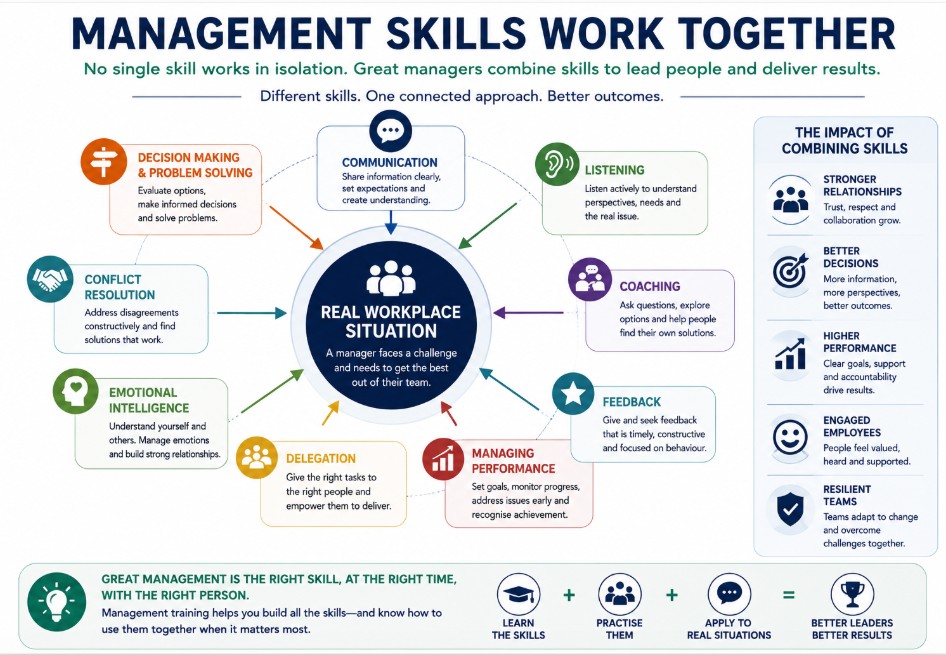
Management Skills Are Connected
Although these skills have been explored individually, effective management rarely involves using just one of them.
Consider a manager addressing declining performance.
They may need to listen to understand what is happening, use emotional intelligence to recognise how the employee is responding, provide clear feedback, use coaching to explore solutions and make appropriate decisions about what happens next.
Similarly, effective delegation requires communication, trust, judgement and feedback.
This interconnectedness is why comprehensive management training programmes can be particularly valuable. Rather than teaching individual techniques in isolation, they help managers understand how different skills work together in real workplace situations.
Management Training Across the South West
Organisations across Somerset, Devon, Dorset and Cornwall face many of the same management challenges explored in this chapter.
A supervisor in a Somerset manufacturing business may need greater confidence delegating to experienced employees. A hospitality manager in Cornwall may be leading a seasonal team with varying levels of experience. A growing business in Devon may need managers who can lead change, while an organisation in Dorset may be preparing technically experienced employees for their first people-management roles.
The industries and circumstances differ, but the underlying need is similar: managers need practical skills that enable them to get the best from people while delivering organisational results.
Effective management training in the South West should therefore be relevant to the organisation and the people attending it. Using participants' real situations, challenges and workplace examples makes it easier to transfer learning from the training room into everyday management practice.
Chapter 4: In Brief
Effective managers need far more than technical expertise. Communication, listening, delegation, coaching, feedback, emotional intelligence, performance management and decision making all influence how successfully managers lead people.
These skills can be learned.
The strongest management training programmes combine knowledge with practice, reflection and feedback, helping managers turn management principles into everyday behaviours.
Ultimately, management development is not about creating one particular type of manager. It is about giving people a sufficiently broad toolkit to adapt their approach to different people, challenges and situations.
Chapter 5 - Common Management Challenges and How Training Can Help
"Management becomes most challenging when there is no obvious answer. Developing managers means giving them the confidence, skills and judgement to handle those moments well."
Training South West Management Training Team
Knowing what good management looks like is one thing. Applying it when workloads are high, employees disagree, performance drops or a difficult conversation needs to happen is quite another.
Managers rarely struggle because they do not care about doing a good job. More often, they find themselves dealing with situations for which they have had little preparation.
A technically experienced employee may suddenly be expected to manage former colleagues. A confident manager may struggle when faced with an emotional performance conversation. Another may find themselves so overwhelmed by their own workload that they have little time left to actually manage their team.
These are exactly the situations where management training can make a difference.
Rather than expecting managers to learn everything through trial and error, effective management training gives them practical frameworks, opportunities to practise and the confidence to approach challenging situations more deliberately.
Although every workplace is different, there are several management challenges that appear repeatedly across organisations.
1. Moving From Colleague to Manager
Becoming the manager of people who were previously your colleagues can be one of the most uncomfortable transitions in a management career.
Relationships change.
Someone who was previously part of conversations about the manager may now be responsible for setting expectations, allocating work and addressing performance.
New managers sometimes respond by moving towards one of two extremes.
They may become overly authoritative because they feel they need to establish their position. Alternatively, they may avoid making difficult decisions because they are worried about damaging friendships.
Neither approach is particularly effective.
The goal is not to abandon existing relationships but to establish new boundaries around them.
Managers need to be clear about their responsibilities, treat people consistently and understand that being respected is ultimately more important than trying to remain everyone's friend.
How Management Training Helps
First-time manager training can help people explore the psychological transition from team member to manager before problems arise.
Managers can discuss boundaries, fairness, confidentiality and authority while practising situations in which they may need to challenge someone they previously considered a peer.
Understanding that this discomfort is a normal part of the transition can itself build confidence.
2. Struggling to Delegate
Delegation is one of the most common management challenges.
Managers often know intellectually that they should delegate, yet still find reasons not to.
"It will be quicker if I do it myself."
"They're already busy."
"This is too important."
"I'll need to check it anyway."
"They won't do it the way I would."
The result is predictable.
The manager becomes overloaded while employees remain dependent upon them.
Effective delegation requires trust, but it also requires skill. Managers need to decide what can be delegated, identify the right person, communicate expectations clearly and establish appropriate checkpoints without micromanaging.
How Management Training Helps
During a management training workshop, managers can analyse their existing workload and identify tasks they may be holding onto unnecessarily.
They can also examine why they are reluctant to delegate.
Sometimes the issue is trust. Sometimes it is perfectionism. Sometimes managers have simply never learned how to delegate effectively.
Practical management training turns delegation from something managers know they should do into something they understand how to do.
3. Avoiding Difficult Conversations
One of the clearest differences between confident and inexperienced managers is often how quickly they address uncomfortable issues.
Problems rarely improve because nobody talks about them.
A manager may notice declining performance, inappropriate behaviour, repeated lateness or tension between colleagues but postpone the conversation because they are uncertain how the employee will react.
Days become weeks.
The issue becomes more established and colleagues begin wondering why nothing is being done.
Eventually, the conversation becomes significantly more difficult than it needed to be.
How Management Training Helps
Difficult conversations are an area where practical management training is particularly valuable.
Managers can learn how to prepare, separate facts from assumptions, open the conversation constructively, listen to the employee's perspective and establish clear expectations.
More importantly, they can practise.
Role play sometimes makes participants uncomfortable—and that is partly why it works. It allows managers to experience some of the pressure of a challenging conversation while still being able to pause, receive feedback and try a different approach.
It is far better to practise an uncomfortable conversation in a training room than for the first attempt to be with an employee when the outcome genuinely matters.
4. Managing Poor Performance
Poor performance can be difficult to manage because its cause is not always immediately obvious.
An employee may lack knowledge or skill. Expectations may be unclear. They may not have the resources they need. Motivation may have declined. There may be a personal issue affecting work.
Or the employee may simply not be meeting a reasonable standard.
Effective managers avoid jumping immediately to conclusions.
They begin by establishing the facts, clarifying expectations and understanding what may be contributing to the problem.
Support may be appropriate, but support and accountability are not opposites. Managers can help an employee improve while remaining clear about the standards that need to be achieved.
How Management Training Helps
Performance management training gives managers a structured approach to diagnosing and addressing performance issues.
Managers can practise distinguishing between capability, motivation and behavioural problems and consider how their response should differ in each situation.
They also learn the importance of addressing concerns early, documenting appropriately and maintaining regular conversations rather than relying solely on formal appraisal processes.
5. Giving Constructive Feedback
Many managers are comfortable telling someone they have done a good job.
Fewer are comfortable explaining that something needs to change.
As a result, feedback sometimes becomes vague:
"You need to be more professional."
"Your attitude needs to improve."
"You need to communicate better."
The employee may leave the conversation knowing that their manager is unhappy but having little idea what they are expected to do differently.
Useful feedback is specific.
It describes observable behaviour, explains its impact and provides enough clarity for the individual to understand what should continue or change.
How Management Training Helps
During management training, managers can practise converting vague feedback into clear, constructive messages.
For example:
Instead of:
"You need to communicate better."
A manager might say:
"During the last two project meetings, you interrupted colleagues several times while they were explaining their ideas. I'd like you to give people the opportunity to finish before responding."
The second version gives the employee something concrete to work with.
Learning feedback models can help, but practising the language is what builds confidence.
6. Managing Conflict Between Team Members
Managers sometimes hope that employees will resolve disagreements themselves.
Often they do.
But when conflict begins affecting communication, morale or performance, ignoring it can allow positions to become increasingly entrenched.
Managers do not necessarily need to decide who is right and who is wrong.
Their role may instead be to create a constructive conversation in which both individuals can explain their perspective, identify the underlying issue and agree how they will work together going forward.
How Management Training Helps
Conflict management exercises allow managers to explore the difference between healthy disagreement and destructive conflict.
Through case studies and role play, managers can practise remaining neutral, asking questions, reframing emotional statements and moving conversations towards solutions.
These skills are particularly important when the manager has their own opinion about the disagreement and must consciously avoid taking sides too quickly.
7. Managing Different Personalities and Working Styles
Managers do not lead identical people.
Some employees want frequent discussion and feedback. Others prefer greater independence.
Some think aloud. Others need time to process information.
Some respond enthusiastically to change while others want to understand every detail before committing.
Effective management therefore requires flexibility.
Treating employees fairly does not always mean managing everybody in exactly the same way. It means maintaining consistent standards while recognising that different people may need different forms of communication, support and motivation.
How Management Training Helps
Management development can help managers recognise their own preferred style and understand that it may not work equally well with everyone.
Activities exploring communication styles, personality preferences or workplace scenarios encourage managers to expand their range.
The objective is not to label employees. It is to help managers become more adaptable.
8. Motivating a Disengaged Team
When engagement falls, managers sometimes ask:
"How do I motivate my team?"
A more useful question may be:
"What is making it difficult for my team to feel motivated?"
People rarely become disengaged for no reason.
Unclear priorities, lack of recognition, excessive workload, limited development, poor communication, lack of autonomy or repeated organisational change can all contribute.
Managers may not be able to fix every organisational issue, but they often have considerable influence over the day-to-day experience of their employees.
How Management Training Helps
Management training helps managers explore what genuinely drives engagement rather than relying on short-term incentives or motivational speeches.
They can examine factors within their control, such as recognition, communication, autonomy, development, involvement and clarity.
This shifts the manager's focus from trying to manufacture motivation towards creating conditions in which people are more likely to feel engaged.
9. Managing Hybrid and Remote Teams
Hybrid working creates management challenges that are different from those experienced when everyone works in the same place.
Managers need to maintain communication and team cohesion without creating unnecessary meetings or making remote employees feel they are constantly being monitored.
They also need to ensure that visibility does not become confused with performance.
Someone sitting in an office is not automatically contributing more than someone working elsewhere.
Clear objectives, agreed communication practices, trust and an emphasis on outcomes become increasingly important.
How Management Training Helps
Modern management training programmes can help managers develop approaches for leading dispersed teams, running effective virtual conversations and maintaining accountability without micromanagement.
Managers can also explore issues such as inclusion, communication overload and ensuring that employees who are physically present do not inadvertently receive greater access to information or opportunities.
10. Managing Workload and Feeling Overwhelmed
Management can feel relentless.
A manager may begin the day with a clear plan and, within an hour, find themselves responding to emails, employee questions, customer problems and unexpected meetings.
When this happens repeatedly, managers can become trapped in reactive working.
Their own tasks are completed after hours while important management activities—one-to-ones, coaching, planning and development—are repeatedly postponed.
Ironically, failing to make time for management often creates even more work.
Employees become more dependent, problems are identified later and the manager remains the person everyone relies upon.
How Management Training Helps
Management training can help managers look beyond traditional time-management techniques and examine the behaviours contributing to overload.
Questions might include:
What could I delegate?
Which meetings genuinely need me?
Which problems could my team solve themselves?
Where am I creating dependency?
What important management activities am I sacrificing because they never feel urgent?
Sometimes the most effective time-management strategy for a manager is simply to manage differently.
11. Leading Through Change and Uncertainty
Managers are frequently expected to lead changes they did not personally decide upon.
A restructuring may be announced. A new system may be introduced. Artificial intelligence may change established processes. Budgets may tighten or responsibilities may shift.
Employees naturally turn to their manager with questions.
Sometimes the manager does not have the answers either.
Strong management during change is therefore not about pretending to have certainty. It is about communicating honestly, explaining what is known, acknowledging what is not known and helping employees focus on what they can control.
How Management Training Helps
Change management training gives managers frameworks for understanding common reactions to change and helps them practise communicating when information is incomplete.
Managers learn that resistance is not always negativity. Questions and concerns can provide useful information about what employees need in order to move forward.
12. Lacking Confidence as a New Manager
One of the least discussed management challenges is confidence.
New managers can privately wonder:
"What if I don't know the answer?"
"What if the team doesn't respect me?"
"What if someone challenges me?"
"What if I make the wrong decision?"
This uncertainty can lead managers to become overly controlling, avoid decisions or imitate management styles they have experienced previously.
Confidence rarely arrives on the day someone receives a management title.
It develops through experience.
How First-Time Manager Training Builds Confidence
Structured training for new managers provides a foundation before every management lesson has to be learned the hard way.
Participants discover that many of the challenges they are experiencing are shared by other managers. They gain practical frameworks, practise situations and have an opportunity to discuss approaches with peers.
Perhaps most importantly, they learn that good management does not require having an immediate answer to every question.
It requires knowing how to find the right way forward.
Real Workplace Scenario: A New Manager in Cornwall
A growing hospitality business in Cornwall promoted an experienced employee to supervise a team that included several people she had worked alongside for years.
Initially, she tried to maintain exactly the same relationships she had before becoming manager.
When one former colleague repeatedly arrived late, she avoided addressing the issue. She worried that raising it would make the relationship awkward and hoped the problem would resolve itself.
Instead, other team members began noticing that the behaviour was going unchallenged. One employee eventually questioned why expectations seemed to apply differently to different people.
During a first-time management training programme, the manager explored the difference between being friendly and avoiding accountability. She practised preparing for a conversation, describing the issue objectively and explaining expectations without becoming confrontational.
She subsequently spoke privately with the employee, listened to the reasons behind the lateness and agreed what needed to change.
The conversation was considerably easier than she had anticipated.
More importantly, she recognised something fundamental about her new role:
Fair management sometimes requires conversations that friendship allows us to avoid.
Inside a Management Training Workshop: The Management Challenge Clinic
One particularly effective approach to management training is to work with the challenges participants are actually experiencing.
Each manager identifies a current workplace situation without naming the individuals involved.
For example:
"One member of my team dominates every meeting."
"I've delegated something but I'm constantly checking it."
"Two experienced employees won't work together."
"I need to address someone's performance but keep putting it off."
"My team comes to me with every problem."
Participants work together to identify:
- What is actually happening?
- What management skill is required?
- What assumptions might the manager be making?
- What conversation needs to happen?
- What could the manager do differently?
The group can then practise possible approaches.
This type of activity makes management training immediately relevant because participants leave with practical ideas they can apply to situations waiting for them back at work.
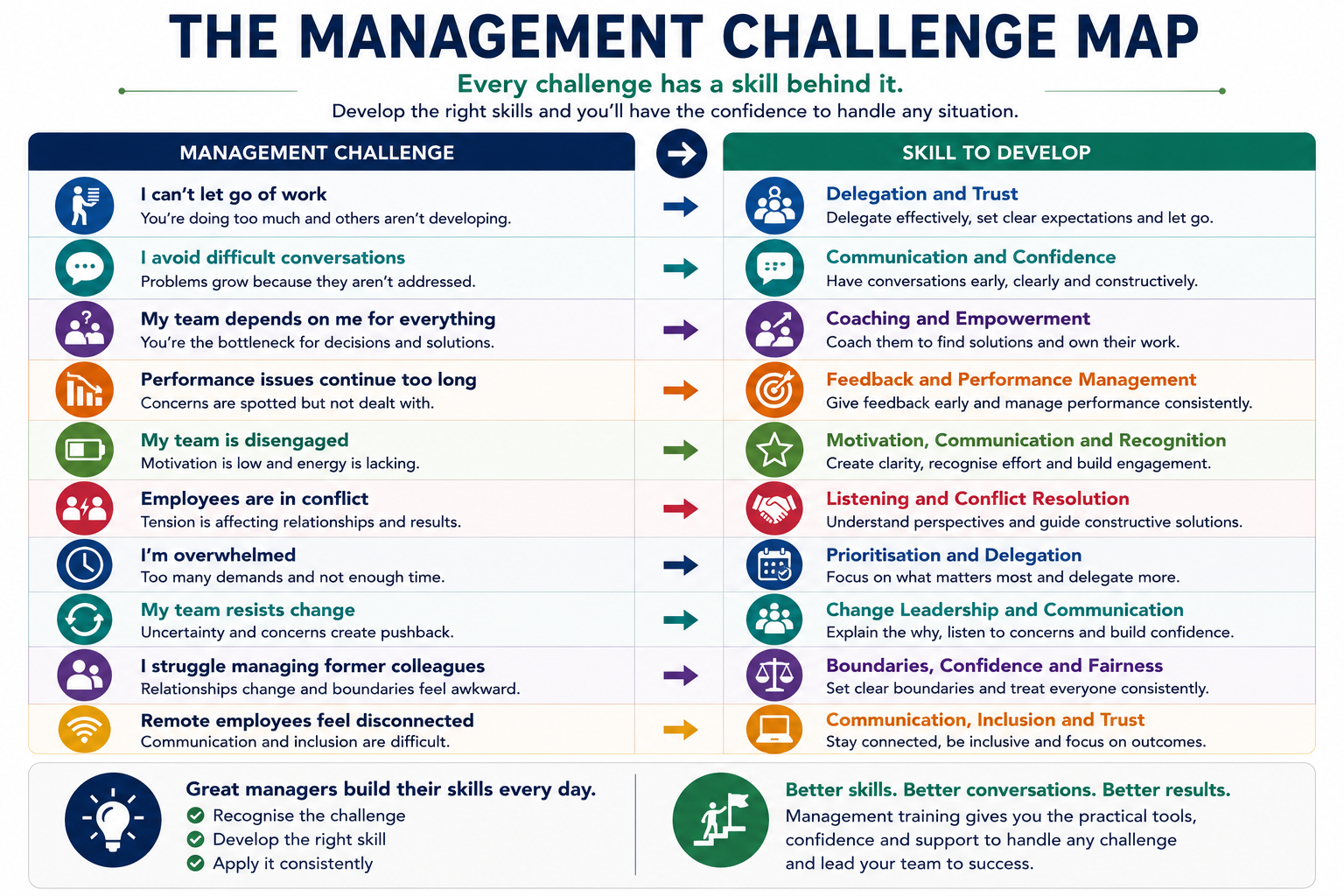
| Management Challenge |
Skills to Develop |
| I can't let go of work |
Delegation and trust |
| I avoid difficult conversations | Communication and confidence |
| My team depends on me for everything | Coaching and empowerment |
| Performance issues continue too long | Feedback and performance management |
| My team is disengaged | Motivation, communication and recognition |
| Employees are in conflict | Listening and conflict resolution |
| I'm overwhelmed | Prioritisation and delegation |
| My team resists change | Change leadership and communication |
| I struggle managing former colleagues | Boundaries, confidence and fairness |
| Remote employees feel disconnected | Communication, inclusion and trust |
The important point is that management challenges are rarely solved by working harder.
They are often solved by developing a different management skill.
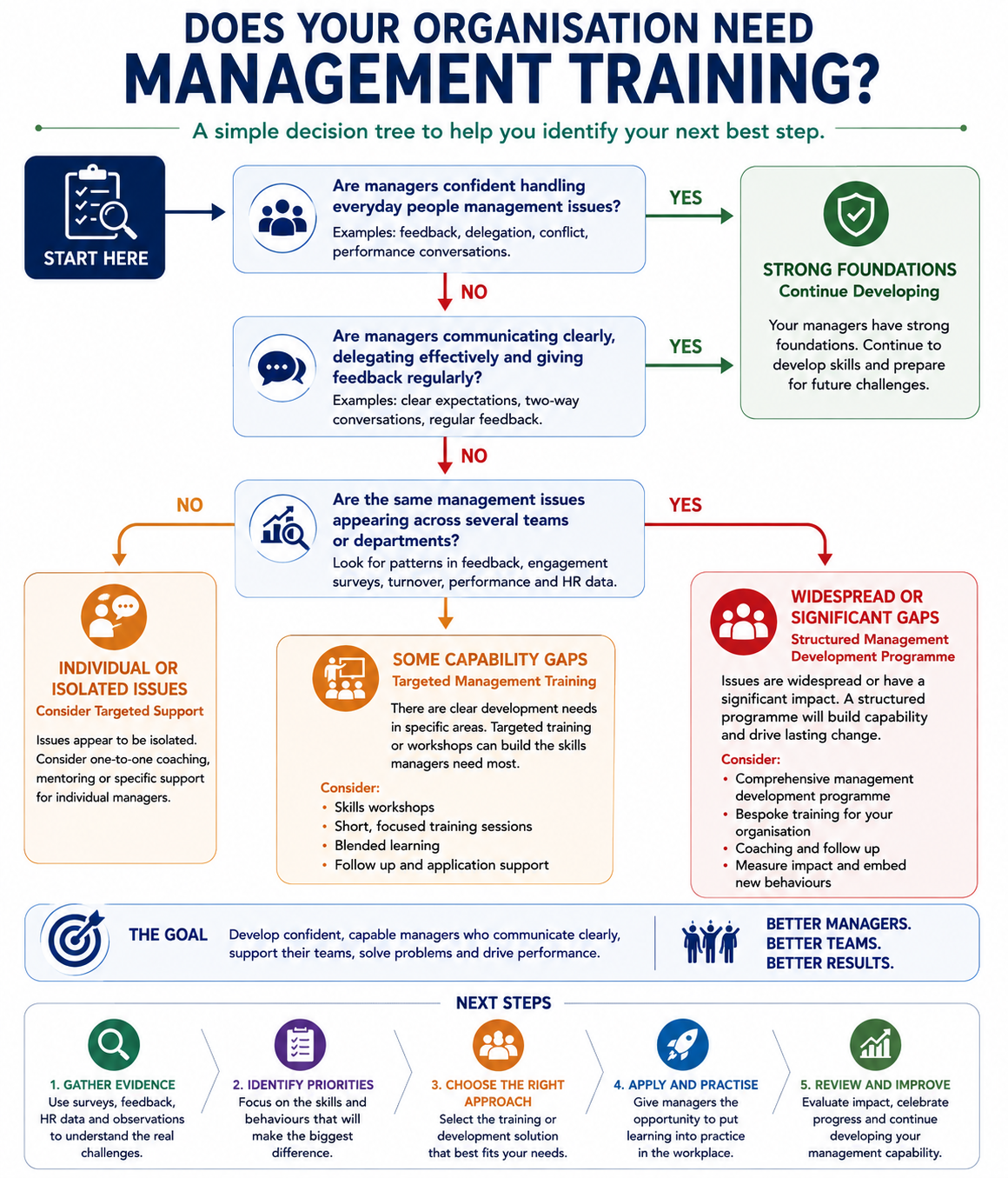
When Does an Organisation Need Management Training?
Individual management problems can sometimes reveal a wider organisational development need.
Signs that an organisation may benefit from management training include:
- managers repeatedly avoiding difficult conversations;
- inconsistent management approaches between teams;
- high employee turnover within particular departments;
- new managers receiving little support after promotion;
- employees reporting poor communication;
- managers becoming overwhelmed because they struggle to delegate;
- performance issues remaining unresolved;
- conflict frequently being escalated to HR;
- managers struggling to lead organisational change;
- low employee engagement;
- managers lacking confidence in giving feedback; and
- technically capable employees struggling with people management responsibilities.
One isolated issue does not necessarily indicate a training need.
However, when the same management challenges appear repeatedly across an organisation, developing management capability can address the underlying cause rather than continually responding to individual symptoms.
Management Challenges Across the South West
Organisations across Somerset, Devon, Dorset and Cornwall operate in very different sectors, but many of the management challenges are remarkably similar.
A supervisor in a Somerset manufacturing business may struggle to manage former colleagues. A hospitality manager in Cornwall may need to motivate a seasonal team. A professional services manager in Devon may be learning how to manage hybrid employees, while a growing Dorset business may have promoted several technically capable employees into management roles for the first time.
The context changes.
The underlying management skills often do not.
This is why effective management training in the South West should not rely solely on generic theory. Training becomes significantly more valuable when managers can apply learning to their own employees, teams and workplace situations.
Manager's Takeaway
Management challenges rarely arrive neatly labelled. A difficult employee conversation may require listening, emotional intelligence, feedback, judgement and confidence at the same time. Effective management training helps managers recognise which skills a situation requires and gives them the opportunity to practise using those skills before the stakes are high.
Chapter 6: Types of Management Training – Which Approach Is Right for Your Organisation?
"The best management training isn't simply a course managers attend. It gives them the right development, at the right stage of their career, and helps them turn learning into better management back in the workplace."...
Training South West Training Team
There is no single type of management training that is right for every manager or every organisation.
A newly promoted team leader may need help making the transition from colleague to manager, while an experienced manager may need to strengthen specific skills such as coaching, delegation or performance management. Senior managers may need greater focus on strategic thinking, change leadership and developing other managers.
The way training is delivered matters too.
For some organisations, a focused half-day management workshop may address an immediate skills gap. Others may benefit from a structured management development programme delivered over several months, allowing managers to learn, practise and apply new approaches between sessions. Coaching, virtual training and blended learning can provide further options.
Choosing the right management training therefore begins with understanding three things:
- Who are you developing?
- What do they need to be able to do differently?
- What type of learning will give them the best opportunity to make that change?
The strongest management training programmes are designed around those questions rather than simply selecting a course from a list.
1. First Time Manager Training
The transition into a first management role is one of the most significant changes in a person's career.
Employees are often promoted because they have demonstrated technical expertise, reliability or strong performance. However, becoming responsible for other people introduces an entirely new set of expectations.
Suddenly, they may need to delegate work they previously completed themselves, give feedback to colleagues, manage performance, resolve conflict and make decisions that affect other people's working lives.
They may also find themselves managing people who were previously their peers.
First-time manager training helps people make this transition deliberately rather than expecting them to learn everything through experience.
Training will commonly explore areas such as:
- understanding the role and responsibilities of a manager;
- moving from colleague to manager;
- setting expectations;
- communication and active listening;
- delegation;
- giving feedback;
- coaching;
- motivation;
- managing performance;
- difficult conversations;
- managing priorities; and
- building confidence as a manager.
The objective is not to teach new managers everything they will ever need to know.
It is to give them a strong foundation and a practical toolkit they can begin using immediately.
Who Is It Best For?
First-time manager training is particularly suitable for employees preparing for promotion, newly appointed managers, team leaders and supervisors who have received little previous formal management development.
2. Line Manager Training
Line managers have perhaps the greatest day-to-day influence on the employee experience.
They translate organisational priorities into everyday work, answer questions, allocate responsibilities, give feedback, manage performance and provide the connection between employees and the wider organisation.
This makes line manager training particularly important.
Even experienced line managers can develop habits over time. Some may avoid difficult conversations. Others may become too involved in operational work, struggle to delegate or rely heavily on one particular management style.
Line manager training can strengthen core management capabilities while helping create greater consistency across an organisation.
Common areas include:
- effective communication;
- managing performance;
- setting objectives;
- giving feedback;
- conducting one-to-one meetings;
- delegation;
- coaching;
- employee motivation;
- managing conflict;
- supporting development;
- managing change; and
- creating accountability.
For organisations with several managers, developing these capabilities together can also create a shared management language and clearer expectations about what good management looks like.
3. Supervisor Training
Supervisors frequently occupy a challenging position.
They are close to day-to-day operations while also being expected to manage people, maintain standards and implement decisions made elsewhere in the organisation.
In sectors such as manufacturing, hospitality, construction, logistics and customer service, supervisors may have progressed because of their practical experience rather than because they originally intended to pursue a management career.
Supervisor training helps bridge the gap between technical or operational expertise and people management.
Training may focus on communication, delegation, managing workloads, giving instructions, addressing problems early, motivating teams, handling conflict and maintaining appropriate standards.
Practical scenarios are especially valuable because supervisors often need management techniques that can be applied immediately in fast-moving operational environments.
4. Middle Management Training
Middle managers face a different challenge.
They are often required to manage both downwards and upwards.
They need to lead their own teams while interpreting senior leadership priorities, influencing stakeholders, coordinating with other departments and sometimes managing other managers.
As a result, middle management training tends to move beyond the fundamentals of managing individuals.
Development may include:
- influencing and stakeholder management;
- leading through change;
- strategic thinking;
- decision making;
- developing high-performing teams;
- coaching other managers;
- managing competing priorities;
- cross-functional collaboration;
- communication with senior leaders; and
- translating organisational strategy into action.
Middle management development is particularly important because these managers frequently determine whether organisational strategy successfully becomes everyday behaviour.
5. Senior Management Training
As management responsibility increases, the focus of development changes again.
Senior managers need to look beyond immediate operational performance and consider organisational capability, culture, future priorities and longer-term risks.
They may also be responsible for developing other managers rather than directly supervising large numbers of employees themselves.
Senior management development may therefore concentrate on areas such as:
- strategic leadership;
- organisational decision making;
- leading change;
- influencing;
- culture;
- communication;
- developing management capability;
- succession planning;
- innovation;
- commercial awareness; and
- leading through uncertainty.
At this level, development is often most effective when participants can work with complex organisational challenges rather than generic management scenarios.
6. Leadership Management Training
The terms leadership training and management training are sometimes used interchangeably, but they are not exactly the same.
Management is typically concerned with turning objectives into action: organising work, managing people, maintaining standards and delivering results.
Leadership places greater emphasis on direction, influence, vision, culture and bringing people with you.
In practice, effective managers need both.
A manager may need strong organisational skills to ensure work is delivered while also needing leadership skills to motivate people through a difficult period of change.
For this reason, leadership and management training often combines practical management capability with broader leadership development.
The balance should depend on the responsibilities and experience of the participants rather than assuming that every manager needs the same mixture.
7. Management Skills Workshops
Not every organisation needs a complete management development programme.
Sometimes there is a clearly defined need.
Managers may need greater confidence having difficult conversations. An engagement survey may reveal problems with feedback. A restructure may mean managers need help leading through change.
A targeted management skills workshop can concentrate on a particular capability.
Examples might include:
- delegation skills;
- coaching skills for managers;
- giving effective feedback;
- difficult conversations;
- performance management;
- conflict management;
- communication skills;
- managing change;
- managing hybrid teams; or
- time management and prioritisation.
Focused workshops can be particularly effective when managers already have a good foundation but need to strengthen one specific area.
They can also form part of a wider management development programme.
8. Bespoke Management Training
Off-the-shelf management training can provide a useful foundation, but organisations do not all experience the same challenges.
A rapidly growing business promoting several employees for the first time has different requirements from an established organisation trying to improve accountability among experienced managers.
Bespoke management training allows the programme to be shaped around the organisation.
This may involve adapting:
- learning objectives;
- scenarios and case studies;
- terminology;
- organisational values;
- management competencies;
- policies and processes;
- industry context;
- participant experience; and
- specific workplace challenges.
The advantage is relevance.
When participants recognise the situations being discussed, they can more easily connect the training with what happens in their own workplace.
Bespoke training can also allow managers to work on genuine organisational issues during the programme, creating a direct connection between learning and business performance.Enter your text here ...
9. Face to Face Management Training
Despite the growth of digital learning, face-to-face management training remains particularly valuable when the objective is behavioural development.
Management involves people.
Learning how to give feedback, coach an employee or handle conflict therefore benefits from interaction.
In a face-to-face environment, participants can practise conversations, observe different approaches, receive immediate feedback and learn from the experiences of other managers.
Trainers can also respond to what is happening in the room, exploring issues in greater depth when they are particularly relevant to the group.
Face-to-face training can work especially well for:
- role play and conversation practice;
- group problem solving;
- management case studies;
- peer learning;
- behavioural feedback;
- team-based management development; and
- sensitive or complex management topics.
It can also help create relationships between managers who may need to work together after the programme ends.
10. Online and Virtual Management Training
Virtual management training can provide flexibility when managers work across different locations or when bringing everyone together physically would be difficult.
Well-designed online training should not simply replicate a classroom presentation on screen.
Interactive virtual management training can include breakout discussions, case studies, polls, practical exercises and opportunities to practise conversations.
Shorter sessions delivered over time can also work well virtually, allowing managers to learn a concept, apply it in the workplace and return to discuss what happened.
Online management training may be particularly useful for geographically dispersed organisations or where managers need access to development without significant travel.
11. Blended Management Training
For some organisations, the strongest solution is not choosing between face-to-face and online learning.
It is combining them.
A blended management development programme might include:
Management workshop
↓
Workplace application
↓
Virtual follow-up
↓
Coaching
↓
Further workshop
↓
Review and reflection
This creates an important rhythm between learning and application.
Managers have time to try new approaches in their workplace, discover what works, identify where they struggled and bring those experiences back into the next development session.
This helps management development become a process rather than an event.
12. 1:1 Management Training
Training develops knowledge and skills across a group.
Coaching allows greater focus on the individual.
Management coaching can be particularly valuable when a manager has a specific challenge, is taking on significantly greater responsibility or needs confidential space to reflect on their approach.
A coaching conversation might explore:
- a difficult employee relationship;
- confidence;
- influencing senior stakeholders;
- delegation;
- leadership style;
- managing priorities;
- career progression; or
- a complex organisational challenge.
Coaching can be used independently or alongside management training.
When combined, training provides the toolkit while coaching helps the individual decide how best to apply it.
13. Ongoing Management Training Programmes
Some of the strongest management development does not happen in a single day.
Behaviour takes time to change.
A manager may understand a delegation model during a workshop but only discover their real difficulty when they attempt to delegate an important responsibility the following week.
An ongoing management development programme creates opportunities to learn, apply, reflect and improve.
For example:
Session 1: The role of the manager and communication
Workplace practice: Hold a different type of one-to-one conversation
Session 2: Delegation and coaching
Workplace practice: Delegate a meaningful responsibility
Session 3: Feedback and performance management
Workplace practice: Hold a feedback conversation
Session 4: Difficult conversations and conflict
Workplace practice: Address a genuine management issue
Follow-up: Review changes, challenges and next development priorities
This approach helps managers build confidence progressively and creates greater accountability for putting learning into practice.
Which Type of Management Training is Best?
There is no universally 'best' management training format.
The right solution depends on the problem you are trying to solve.
| If you need to... |
Consider |
| Prepare people for their first management role |
First-time manager training |
| Strengthen everyday people-management skills | Line manager training |
| Develop operational team leaders | Supervisor training |
| Develop managers managing managers or multiple functions | Middle management development |
| Build strategic capability | Senior management development |
| Address one specific skills gap | Targeted management workshop |
| Develop several capabilities over time | Management development programme |
| Address organisation-specific challenges | Bespoke management training |
| Practise conversations and behaviours | Face-to-face management training |
| Develop managers across different locations | Virtual management training |
| Combine flexibility with practical development | Blended management training |
| Support an individual challenge | Management coaching |
The key question is therefore not:
"Which management course should we buy?"
A better question is:
"What do we need our managers to be able to do better after the training?"
Once that is clear, decisions about content, format and duration become much easier.
Real Workplace Scenario: Developing New Managers in Dorchester, Dorset
A growing Dorset organisation within the hospitality industry, had expanded rapidly and promoted several experienced employees into management positions within a relatively short period. The new managers had excellent knowledge of the organisation but very different levels of management experience and work experience generally (one was a new graduate, one had completed an apprenticeship qualification and 3 others had been with the organisation since its inception a couple of years ago.
Initially, the organisation considered sending each manager on an individual open management course. However, after reviewing the challenges they were experiencing, it became clear that many were shared. Managers were struggling with delegation, difficult conversations, giving feedback and making the transition from colleague to manager. The organisation also wanted them to develop a more consistent approach across different teams.
Rather than focusing on isolated courses, the business introduced a tailored management development programme for the group.
Managers attended practical workshops together, worked on genuine workplace scenarios and were given activities to apply between sessions, which created two benefits.
The first benefit is that the individual managers were able to develop practical skills and confidence, and the second benefit is that the organisation began developing a more consistent management culture.
The question had changed from:
"Which course should each manager attend?"
to:
"What kind of managers do we want to develop across our organisation?"
That proved far more useful.
Inside a Management Training Workshop: Making Training Relevant
Imagine a session on delegation, where participants begin by listing everything they are currently responsible for.
They brainstorm the following three areas, and consider which activities:
- Only they can do
- They can delegate
- They should already have delegated
During the next part of this session, they choose one genuine responsibility and work through:
- Who could take this on?
- What outcome do I need?
- What authority will they have?
- What support will they need?
- When will we review progress?
- What is stopping me from delegating it now?
Although a simple activity, by doing it within a group and with peers, in a structured and facilitated manner, the manager is able to leave the training with more than an understanding of delegation. They leave with a tangible understanding of areas that should be delegated and concrete plans that can be actions upon their return to the workplace.
The distinction between learning about management and practising management, is one of the most important factors to consider when choosing management training.
Face-to-Face Management Training in the South West
For organisations across Somerset, Devon, Dorset and Cornwall, onsite management training can offer several practical advantages.
Bringing a trainer into the workplace reduces the need for groups of managers to travel and allows programmes to be designed around the organisation's own circumstances.
More importantly, managers attending together can work on shared challenges.
A manufacturing business in Somerset may want supervisors to become more confident managing performance. A growing professional services company in Devon may need newly promoted managers to develop coaching and delegation skills. A Dorset organisation may want greater consistency across its management team, while a hospitality business in Cornwall may need managers who can confidently lead varied or seasonal teams.
The industries may differ, but the principle is the same.
Management training is most valuable when managers can see a clear connection between what happens in the training room and what happens when they return to work.
For this reason, organisations choosing management training should look beyond course titles and consider how far the training can be adapted to their people, culture, objectives and real workplace challenges.
What Should You Look for in a Management Training Provider?
The training format is only part of the decision.
Organisations should also consider how the training itself will be delivered.
Useful questions include:
- Does the trainer have genuine management development experience?
- Can the programme be tailored to our organisation?
- Will participants practise management situations or mainly listen to presentations?
- Are workplace scenarios relevant to our managers?
- Will the trainer adapt to different levels of experience in the room?
- How will participants apply learning after the training?
- Is follow-up support available?
- Can the programme develop over time if our needs change?
A good management trainer should be able to explain not simply what they will teach, but how the training will help managers behave differently afterwards.
That is ultimately the purpose of management development.
Manager's Takeaway
The best management training is not necessarily the longest programme, the most expensive course or the one covering the greatest number of topics. It is the training that addresses the right needs, gives managers opportunities to practise and helps them apply what they learn back in the workplace.
Chapter 6: In Brief
Management training can take many forms, from first-time manager courses and targeted skills workshops to coaching and long-term management development programmes.
The right approach depends on the managers, the organisation and the change you want the training to create.
New managers may need a strong foundation. Experienced managers may need targeted development. Groups of managers may benefit from learning together, while individuals may require coaching around particular challenges.
Delivery format matters, but relevance and application matter more.
Effective management training should ultimately help managers do something differently: communicate more clearly, delegate more effectively, tackle difficult conversations sooner, coach their people, manage performance or lead their teams with greater confidence.
That is the real measure of whether management training is the right fit.
Chapter 7: How to Identify Your Management Training Needs
"Effective management development starts with understanding the problem you are trying to solve. Train for the management behaviours your organisation needs, not simply the topics that appear on a course list."...
Eliza Elliot-Browne, Trainer with Training South West
Investing in management training is important, but deciding that managers need development is only the beginning.
The next question is more important:
What do your managers actually need to become better at?
An organisation experiencing high employee turnover may assume that managers need motivation training. The underlying issue might actually be poor communication, inconsistent feedback or managers avoiding performance conversations.
Another organisation may believe it needs time management training because its managers are overwhelmed, when the real problem is that they are failing to delegate.
This is why identifying management training needs should begin with the workplace rather than the training catalogue.
The objective is to understand where management capability is already strong, where gaps exist and which improvements would make the greatest difference to employees, teams and organisational performance.
A good management training needs analysis does not have to be complicated. It simply requires organisations to gather information from several perspectives and look for patterns.
What is a Management Training Analysis?
A management training needs analysis is the process of identifying the difference between the management capability an organisation currently has and the capability it needs.
In simple terms:
Where are our managers now?
↓
Where do we need them to be?
↓
What skills or behaviours need to change?
↓
What management training or development will help close the gap?
The focus should be on behaviour rather than simply knowledge.
For example, rather than saying:
"Managers need training in feedback."
ask:
"What do we want managers to do differently?"
The answer might be:
"We want managers to give specific, constructive feedback regularly rather than waiting until formal performance reviews."
That is a much clearer training objective.
It also gives the organisation something it can observe and evaluate after the management training has taken place.
Start with Organisational Training Priorities
Management development should support what the organisation is trying to achieve.
Before identifying individual skills gaps, consider the wider business context.
Is the organisation:
- growing rapidly?
- restructuring?
- introducing new technology?
- adopting artificial intelligence?
- experiencing high employee turnover?
- developing future leaders?
- moving towards hybrid working?
- merging teams or departments?
- introducing new organisational values?
- experiencing problems with performance?
- preparing employees for their first management roles?
- trying to improve employee engagement?
Different organisational priorities require different management capabilities.
A rapidly growing business may need managers who can delegate and develop people rather than continuing to solve everything themselves.
An organisation undergoing significant change may need managers who can communicate uncertainty, respond to resistance and maintain employee engagement.
A business promoting several technical specialists may need first-time manager training covering the fundamentals of people management.
Management training becomes more valuable when there is a clear line between:
Business need → Management behaviour → Development need
1. Ask Managers Where They Need Support
Managers themselves are an obvious source of information.
Ask them.
A simple management development survey can explore areas such as:
- Which parts of managing people do you find most challenging?
- Which conversations do you feel least confident having?
- What takes up more of your management time than it should?
- What situations do you tend to avoid?
- Which management skill would make the biggest difference to your role?
- What situations have you encountered for which you felt unprepared?
- What would you like to become better at over the next 12 months?
Managers may identify needs that are not immediately visible to senior leaders or HR.
A manager may appear confident while privately struggling with difficult conversations. Another may be achieving results but working excessive hours because they cannot delegate.
Self-assessment is therefore useful—but it should not be the only source of evidence.
Sometimes we do not know what we do not know.
2. Listen to Employees
Employees experience management every day.
Their feedback can reveal patterns that managers themselves may not recognise.
Employee engagement surveys, pulse surveys, focus groups and informal feedback can all provide useful information.
Look particularly for recurring comments about:
- unclear communication;
- lack of feedback;
- inconsistent expectations;
- insufficient recognition;
- micromanagement;
- lack of development;
- poor handling of conflict;
- managers avoiding difficult issues;
- lack of trust;
- inconsistent decision making; or
- poor communication during change.
One comment does not necessarily indicate a management training need.
Repeated patterns across teams deserve attention.
For example, if employees in several departments report that they rarely receive useful feedback, this may indicate a broader need for management skills training rather than isolated problems with individual managers.
3. Review Employee Engagement Data
Engagement surveys can provide valuable clues about management capability.
Questions relating to communication, trust, recognition, development, feedback and confidence in management can reveal areas where employees' experience differs significantly between teams.
The objective is not simply to identify low scores.
Look for variation.
If one department has consistently strong engagement while another struggles, ask what may be different about the management experience.
There may be lessons that can be shared internally before external training is even considered.
Equally, if similar issues appear throughout the organisation, a structured management development programme may help establish stronger and more consistent management practices.
4. Look at Employee Turnover
People leave organisations for many reasons, so high turnover should never automatically be blamed on managers.
However, patterns can be informative.
Is turnover significantly higher in particular teams?
Do exit interviews repeatedly mention management behaviour?
Are employees leaving shortly after moving into certain departments?
Do high-performing employees appear to be leaving particular managers?
If the same themes appear repeatedly, management capability may be contributing.
Exit interviews can be particularly valuable because departing employees may be more willing to discuss issues involving communication, recognition, development or management relationships.
Training will not solve every retention problem.
But where management behaviour is contributing, developing managers can form an important part of the solution.
5. Review Performance Management
Another useful question is:
How effectively are managers dealing with performance?
Warning signs include:
- problems continuing for long periods before being addressed;
- managers repeatedly escalating relatively straightforward issues to HR;
- vague or inconsistent objectives;
- employees being surprised by feedback during formal reviews;
- managers avoiding documentation;
- excessive reliance on annual appraisal conversations; or
- very different performance standards between teams.
These patterns may indicate that managers need greater confidence and capability in setting expectations, giving feedback and addressing underperformance.
Performance management training can help managers intervene earlier and make performance conversations part of normal management rather than something reserved for when problems become serious.
6. Examine the Questions Managers Bring to HR
HR teams often have an excellent view of management capability because they see the questions managers repeatedly ask.
Consider whether HR regularly hears:
"What do I say to them?"
"Can you sit in on the meeting?"
"Can HR deal with this?"
"I've ignored this for months. What do I do now?"
"They're not performing, but I haven't actually told them."
"How do I manage someone I used to work alongside?"
There will always be situations where HR involvement is appropriate.
However, if managers routinely escalate everyday people-management responsibilities because they lack confidence, this can indicate a development need.
Good line manager training should help managers understand both when they can manage a situation themselves and when specialist HR support is genuinely required.
7. Observe Management Behaviour
Not every development need appears in data.
Sometimes it can simply be observed.
Senior leaders, HR professionals and trainers may notice that managers:
- dominate conversations rather than listening;
- provide solutions instead of coaching;
- struggle to delegate;
- hold unnecessary meetings;
- avoid challenging behaviour;
- communicate decisions without explaining why;
- fail to recognise good performance;
- become defensive when challenged; or
- manage everyone in exactly the same way.
Observation helps move training needs analysis from:
"What do managers know?"
to:
"What do managers actually do?"
That distinction matters because effective management training is ultimately intended to influence behaviour.
8. Consider Future Management Needs
Training needs should not only be based on today's problems.
Organisations also need to ask:
What will our managers need to be capable of tomorrow?
A business planning significant growth may need managers who can develop larger teams.
An organisation introducing AI may need managers who can lead employees through uncertainty while making responsible use of new technology.
A company expanding geographically may need managers who can lead dispersed teams.
A business with several senior managers approaching retirement may need to strengthen succession planning and develop future leaders.
This is where management development becomes strategic rather than reactive.
Instead of waiting until capability gaps cause problems, organisations can begin developing managers for responsibilities they are likely to face in the future.
9. Review the Needs of New Managers Separately
New managers often require different development from experienced managers.
Someone moving into management for the first time may need foundations such as:
- understanding the manager's role;
- establishing boundaries;
- communication;
- delegation;
- giving feedback;
- setting expectations;
- coaching;
- managing performance;
- difficult conversations; and
- building confidence.
An experienced manager may already be comfortable in these areas but need development in influencing, strategic thinking, change leadership or developing other managers.
Putting everyone through exactly the same management training programme can therefore be inefficient.
Segmenting participants according to experience and responsibility can create more relevant development.
10. Use 360-Degree Feedback
For more experienced managers, 360-degree feedback can provide a valuable perspective.
Feedback is gathered from people who experience the manager from different directions, potentially including:
- their own manager;
- direct reports;
- colleagues;
- internal stakeholders; and
- the manager themselves.
Comparing these perspectives can reveal interesting gaps.
A manager may believe they delegate effectively while their team experiences micromanagement.
Another may believe they communicate clearly while colleagues feel important information arrives too late.
The objective should not be to create a management scorecard or catch people doing something wrong.
Used well, 360-degree feedback creates self-awareness.
That awareness can then inform coaching or management development.
Look for Patterns, Not Isolated Problems
One of the most important principles of management training needs analysis is to avoid designing an entire programme around one incident.
Suppose an employee complains that their manager communicates poorly.
That may be an individual relationship problem.
But if an engagement survey identifies communication problems, exit interviews mention poor communication and several managers say they lack confidence communicating difficult messages, there is a pattern.
Patterns help organisations distinguish between:
Individual issue
↓
Individual coaching or support
and:
Wider capability gap
↓
Management training or development
This helps ensure that training is being used for the right reasons.
Management Needs Checklist
The following questions provide a useful starting point.
Communication
- Do managers communicate expectations clearly?
- Do employees understand organisational and team priorities?
- Do managers listen effectively?
- Are important messages communicated consistently?
Feedback and Performance
- Do employees receive regular feedback?
- Are performance concerns addressed early?
- Can managers explain what good performance looks like?
- Are managers confident having performance conversations?
Delegation and Development
- Do managers delegate meaningful responsibility?
- Are managers overloaded because they retain too much work?
- Do employees have opportunities to develop?
- Do managers coach rather than automatically solve problems?
Relationships and Team Management
- Can managers handle conflict constructively?
- Are relationships based on trust?
- Do managers adapt their approach to different employees?
- Are teams able to disagree without relationships deteriorating?
Management Confidence
- Are new managers adequately prepared?
- Do managers avoid difficult conversations?
- Are routine management issues frequently escalated?
- Do managers feel confident making people-related decisions?
Change and the Future
- Can managers lead employees through change?
- Are managers confident leading hybrid or dispersed teams?
- Can managers communicate effectively when information is incomplete?
- Are managers prepared for the organisation's future needs?
If several questions generate concern, it may be worth exploring those areas in greater depth before deciding what management training is required.
Real Workplace Scenario: Finding the Real Training Need in Dorset and Devon
A growing organisation operating across Dorset and Devon initially approached its management development planning with a simple assumption:
Managers needed communication training.
Employee feedback repeatedly mentioned communication, and senior leaders felt that managers were not keeping their teams sufficiently informed.
Before commissioning training, the organisation looked more closely at the evidence.
The problem turned out to be broader than communication.
Some managers were unclear about what information they were authorised to share. Others avoided difficult messages because they were worried about employees' reactions. Several managers relied heavily on email rather than having conversations, while newly promoted managers lacked confidence answering questions when they did not know all the details.
What initially appeared to be a communication skills gap was actually a combination of:
- management confidence;
- communication skills;
- leading through uncertainty;
- difficult conversations; and
- clarity around the manager's role.
Instead of commissioning a generic communication workshop, the organisation developed a broader management training programme built around the situations managers were genuinely encountering.
The lesson was simple:
The first training request is not always the real training need.
Inside a Management Training Workshop: The Management Skills Audit
A useful management development activity is to ask managers to assess themselves against key capabilities.
Participants rate both their confidence and their effectiveness in areas such as:
| Management Skill |
My Confidence |
My Effectiveness |
| Communication |
1-5 |
1-5 |
| Listening | 1-5 | 1-5 |
| Delegation | 1-5 | 1-5 |
| Coaching | 1-5 | 1-5 |
| Giving feedback | 1-5 | 1-5 |
| Performance management | 1-5 | 1-5 |
| Difficult conversations | 1-5 | 1-5 |
| Conflict management | 1-5 | 1-5 |
| Motivation | 1-5 | 1-5 |
| Leading change | 1-5 | 1-5 |
The distinction between confidence and effectiveness is important.
Someone may feel extremely confident giving feedback but discover that their approach is not particularly effective.
Another manager may use good techniques but lack confidence in their ability.
The development required in those two situations is different.
Managers can then identify:
One strength I should continue using
One capability I want to improve
One workplace situation where I will practise it
This creates a direct connection between management training and workplace application.
From Training Needs to Training Effectiveness
Once the need has been identified, translate it into a clear training objective.
Avoid objectives such as:
"Understand delegation."
Instead consider:
"Managers will be able to identify appropriate opportunities to delegate, communicate the required outcome and establish appropriate levels of support and accountability."
Instead of:
"Learn about difficult conversations."
use:
"Managers will be able to prepare for and conduct constructive conversations about performance or behaviour."
Instead of:
"Improve communication."
use:
"Managers will adapt their communication approach to different employees and communicate expectations, decisions and change more clearly."
Strong objectives make it easier to design relevant management training.
They also make it significantly easier to evaluate whether the training worked.
Management Training across the South West
Organisations across Somerset, Devon, Dorset and Cornwall may have very different training requirements.
A growing manufacturing business in Somerset may need to prepare experienced technical employees for their first supervisory roles.
A professional services organisation in Devon may want managers to develop coaching and delegation skills as teams expand.
A Dorset organisation may identify inconsistent performance management across departments.
A hospitality or tourism business in Cornwall may need managers who can lead teams containing a mixture of permanent, temporary and seasonal employees.
The sectors and situations differ, which is precisely why management development should begin with the organisation's needs rather than a predetermined training package.
For organisations considering management training in the South West, taking time to identify the underlying management challenges allows the training to be tailored around the skills most likely to make a practical difference.
Manager's Takeaway
Do not begin by asking which management course you should book. Begin by asking what you need your managers to do differently. Once the desired behaviour is clear, you can design management training that has a much greater chance of creating meaningful change.
Chapter 7 in Brief
Organisations across Somerset, Devon, Dorset and Cornwall may have very different training requirements.
A growing manufacturing business in Somerset may need to prepare experienced technical employees for their first supervisory roles.
A professional services organisation in Devon may want managers to develop coaching and delegation skills as teams expand.
A Dorset organisation may identify inconsistent performance management across departments.
A hospitality or tourism business in Cornwall may need managers who can lead teams containing a mixture of permanent, temporary and seasonal employees.
The sectors and situations differ, which is precisely why management development should begin with the organisation's needs rather than a predetermined training package.
For organisations considering management training in the South West, taking time to identify the underlying management challenges allows the training to be tailored around the skills most likely to make a practical difference.
Manager's Takeaway
Do not begin by asking which management course you should book. Begin by asking what you need your managers to do differently. Once the desired behaviour is clear, you can design management training that has a much greater chance of creating meaningful change.
Chapter 8: How to Choose the Right Management Training Programme
"The value of management training is not determined by how much content is covered on the day. It is determined by what managers understand, practise and ultimately do differently when they return to work."
Neil Payne, Commisceo Global Consulting
Once an organisation has identified its management development needs, the next challenge is choosing the right management training programme.
There are thousands of management courses available, ranging from short online modules and open workshops to bespoke programmes delivered over several months. Course descriptions can also look remarkably similar, with familiar topics such as communication, delegation, coaching, motivation and performance management appearing repeatedly.
The real difference often lies not in the list of topics but in how the training is designed and delivered.
A good management training programme should connect directly with the situations managers encounter in their everyday roles. It should provide practical tools, opportunities to practise and sufficient flexibility to reflect the organisation, participants and challenges involved.
Before choosing a programme, organisations should therefore look beyond the course title and ask a more important question:
Will this training help our managers manage more effectively when they return to the workplace?
The following factors can help you make that judgement.
1. Start With the Outcome, Not the Course
Before comparing management training providers, be clear about what you want the training to achieve.
Avoid starting with:
"We need a management course."
Instead ask:
"What do we need our managers to be able to do differently?"
Perhaps you want newly promoted managers to feel confident delegating and giving feedback.
Maybe managers are avoiding performance conversations.
Perhaps different departments have developed inconsistent approaches to managing people.
Or the organisation may be growing and need to develop a stronger pipeline of future leaders.
The clearer the desired outcome, the easier it becomes to evaluate whether a particular management training course is appropriate.
Useful outcomes might include:
- managers addressing performance issues earlier;
- greater confidence having difficult conversations;
- improved delegation;
- more effective one-to-one meetings;
- managers using coaching rather than automatically providing solutions;
- clearer communication;
- stronger accountability;
- more consistent management practices;
- improved confidence among new managers; or
- managers better equipped to lead organisational change.
A course containing twenty management topics is not necessarily better than one concentrating deeply on the six capabilities your managers genuinely need.
2. Consider the Experience Level of the Managers
Management training should reflect the experience and responsibilities of the people attending.
A first-time manager and a senior manager may both need development, but they are unlikely to need the same programme.
A newly promoted manager may need to understand delegation, feedback, boundaries, motivation and performance management.
An experienced middle manager may need greater emphasis on influencing, strategic thinking, leading change and developing other managers.
Before choosing training, consider:
Who will be attending?
How much management experience do they have?
Do they manage employees, managers or both?
What situations are they currently finding difficult?
What responsibilities are they likely to take on in the future?
Where experience levels vary considerably, the programme may need to be adapted or participants divided into appropriate groups.
Relevant management training should meet managers where they are rather than assuming everyone begins from the same place.
3. Look for Practical Management Training
Management is a practical discipline.
Managers do not become better at difficult conversations simply by reading a model.
They improve by understanding the principles, seeing how they work and practising using them.
When evaluating a management training programme, therefore, ask how participants will be involved.
Will they:
- discuss genuine workplace situations?
- practise management conversations?
- work through case studies?
- solve management problems?
- receive feedback?
- reflect on their own management behaviour?
- develop actions to apply after the training?
A programme dominated by presentation slides may transfer knowledge, but knowledge alone does not necessarily change behaviour.
Effective management skills training should create opportunities for managers to try different approaches in a safe environment.
4. Check the Trainer's Experience
The quality of the trainer matters.
Management training often involves complex conversations. Participants may raise real issues involving performance, conflict, motivation, confidence or difficult working relationships.
An experienced management trainer needs more than a good presentation.
They need to be able to:
- understand organisational dynamics;
- respond to unexpected questions;
- adapt activities to different participants;
- challenge assumptions constructively;
- facilitate sensitive discussions;
- connect theory with workplace reality;
- recognise when one approach may not work in every situation; and
- create an environment where managers feel comfortable practising.
It is therefore worth understanding the trainer's background.
Ask about their experience delivering management training, the types of organisations they have worked with and how they adapt their approach to different groups.
The trainer should also be able to explain why particular activities are included and what managers should be able to do differently as a result.
5. Decide How Much Customisation You Need
There is nothing inherently wrong with an off-the-shelf management course.
If the requirement is relatively general, an established programme may provide exactly what is needed.
However, the more specific the organisational challenge, the greater the value of customisation.
Bespoke management training can incorporate:
- organisational terminology;
- values and behaviours;
- real workplace scenarios;
- management competencies;
- relevant policies;
- industry-specific challenges;
- existing management processes;
- examples from participants' roles; and
- current organisational priorities.
This makes the learning easier to recognise and apply.
For example, a generic case study might ask managers to discuss an employee missing project deadlines.
A bespoke programme for a manufacturing organisation could explore a supervisor managing performance on a production team.
A programme for a professional services business might use a scenario involving client delivery and competing deadlines.
The underlying management principle may be identical.
The context makes it meaningful.
6. Consider Group Size
Group size can significantly influence the training experience.
Large groups may be appropriate when the objective is primarily to communicate information.
Management skills development usually requires greater interaction.
Managers need opportunities to contribute, discuss experiences, ask questions and practise.
If a group is too large, participants may spend much of the programme listening rather than doing.
Smaller groups can make it easier to:
- involve everyone;
- practise conversations;
- provide individual feedback;
- explore real management challenges;
- encourage discussion; and
- adapt the training as the session develops.
There is no perfect group size for every programme, but organisations should consider whether the proposed number of participants supports the type of learning they want to achieve.
7. Think Carefully About Duration
Another common question is:
How long should management training last?
There is no universal answer.
A focused workshop on giving feedback may only require a few hours.
A programme designed to prepare first-time managers for their roles may require several sessions.
A wider management development initiative may run over several months.
The appropriate duration depends on:
- the number of learning objectives;
- participant experience;
- the complexity of the skills;
- how much practice is required;
- whether workplace application is included; and
- the depth of behavioural change expected.
Be cautious about trying to cover too much too quickly.
Six topics mentioned briefly are not necessarily more valuable than three topics explored properly.
For behavioural skills in particular, managers need time to think, discuss and practise.
8. Decide Between Face-to-Face, Virtual and Blended Training
The best delivery format depends on the organisation and the learning objective.
Face-to-face management training can be particularly effective for behavioural development because managers can practise conversations, interact naturally with colleagues and receive immediate feedback.
Virtual management training provides greater flexibility and can work extremely well for geographically dispersed teams, particularly when sessions are designed specifically for online participation.
A blended management development programme can combine both approaches, perhaps using face-to-face workshops for intensive skills practice and virtual sessions for follow-up, reflection or coaching.
Rather than asking which format is universally best, ask:
Which format gives these managers the best opportunity to learn and practise these particular skills?
Practicality matters too.
Travel, operational requirements, shift patterns and manager availability may all influence the decision.
9. Ask How Real Workplace Challenges Will Be Used
One of the most valuable resources in any management training programme is already in the room:
the managers' own experience.
Participants arrive with genuine situations.
Someone may be struggling with an employee who resists feedback.
Another may be finding delegation difficult.
Someone else may be managing conflict between experienced colleagues.
A skilled trainer can use these situations—while maintaining appropriate confidentiality—to make learning immediately relevant.
Ask potential training providers whether managers will have opportunities to bring their own challenges into the programme.
The best management training should not feel disconnected from the workplace.
The workplace should become part of the learning.
10. Look for Opportunities to Practise
This deserves particular attention.
If you want managers to become better at something, they need opportunities to do it.
A session on coaching should involve coaching.
A session on feedback should involve giving feedback.
A session on difficult conversations should involve practising difficult conversations.
A session on delegation should result in managers considering what they can actually delegate.
Role plays, simulations, case studies, peer discussions and practical exercises allow managers to move from:
"I understand the idea."
to:
"I know how I could use this."
That is a crucial transition.
Inside a Management Training Workshop: Practising the Moment That Matters
Imagine a manager needs to tell an experienced employee that their behaviour in team meetings is affecting colleagues.
Reading a feedback model may help.
But now put the manager into the conversation.
The employee responds:
"I don't agree. Nobody else has ever complained about me."
What happens next?
Does the manager become defensive?
Do they retreat?
Do they over-explain?
Can they remain calm, listen and bring the conversation back to the behaviour that needs addressing?
Practical management training allows the trainer to pause the conversation.
The group can explore what happened, consider alternative responses and allow the manager to try again.
That second attempt is often where some of the most valuable learning occurs.
11. Consider What Happens After the Training
One of the biggest weaknesses of traditional training is what happens afterwards.
Managers attend a course.
They enjoy it.
They return to work.
Their inbox contains 87 emails.
Within days, old habits return.
For management training to create lasting value, organisations should think about how learning will be reinforced.
This might include:
- workplace action plans;
- follow-up sessions;
- coaching;
- manager peer groups;
- practice activities;
- line manager conversations;
- refresher workshops;
- learning resources; or
- reviewing progress after three or six months.
Even something as simple as asking each participant to identify one behaviour they will change immediately can help connect training with workplace application.
The strongest management development programmes create a cycle:
Learn → Practise → Apply → Reflect → Improve
rather than:
Attend → Complete → Forget
12. Look at How Success Will Be Measured
Before management training begins, ask how you will know whether it worked.
Participant satisfaction is useful.
But:
"I enjoyed the course."
is not the same as:
"I manage differently because of the course."
Evaluation might consider:
- participant confidence;
- knowledge and understanding;
- observed behaviour change;
- employee feedback;
- management consistency;
- improvements in performance conversations;
- reductions in unnecessary HR escalation;
- engagement data; or
- relevant organisational outcomes.
The measures chosen should connect directly with the original reason for providing the training.
We will explore this in much greater detail in the next chapter.
Questions to Ask a Management Training Provider
Before commissioning management training, it can be useful to ask:
- How will you understand our training needs before designing the programme?
- Can the management training be tailored to our organisation?
- Who will deliver the training and what management development experience do they have?
- How practical will the training be?
- Will managers have opportunities to practise conversations and skills?
- Can we incorporate real workplace scenarios?
- What group size would you recommend and why?
- What delivery format would work best for our objectives?
- How will managers apply the learning after the programme?
- What follow-up options are available?
- How could we measure the impact of the training?
- Can the programme evolve if additional development needs emerge?
A strong training provider should welcome these questions.
They demonstrate that the organisation is interested not simply in delivering training but in creating meaningful management development.
Real Workplace Scenario: Choosing Management Training for a Growing Business in Weston-super-Mare, Somerset
A growing Somerset business had promoted several experienced employees into supervisory and management roles as the organisation expanded.
Senior leaders initially began searching for a standard two-day management course.
However, conversations with the managers revealed that their biggest challenges were relatively specific.
Several were struggling to delegate because they had previously been technical specialists.
Others lacked confidence giving feedback to former colleagues.
Some were unsure when to coach employees and when to provide clear direction.
Rather than choosing a broad course covering every possible management topic, the organisation developed a bespoke management training programme around those priorities.
The programme combined practical workshops with workplace application between sessions. Managers brought real situations back to later workshops and discussed what they had tried, what had worked and where they were still struggling.
The result was a programme that contained fewer topics than the organisation had initially considered—but considerably more opportunity to practise the behaviours that actually mattered.
The lesson was important:
The best management training programme is not necessarily the one that covers the most. It is the one that changes the most.
Choosing Management Training in the South West
For organisations looking for management training in Somerset, Devon, Dorset or Cornwall, there is another practical consideration: where the training should take place.
Sending several managers to individual courses elsewhere in the country can involve travel costs, time away from the workplace and managers receiving different learning experiences.
Onsite management training provides an alternative.
Bringing the trainer to the organisation can allow groups of managers to develop together while using examples directly relevant to their workplace.
This can be particularly valuable where an organisation wants to create greater consistency across its management team.
Managers can discuss shared expectations, practise approaches together and develop a common understanding of how people should be managed within the organisation.
Local delivery should not, however, be the only consideration.
The quality of the trainer, relevance of the programme and opportunity for practical application remain more important than geography alone.
The objective should be to find management training that combines expertise, relevance and practical application while working effectively for the organisation.
Red Flags When Choosing Management Training
It can also be useful to recognise what may indicate that a programme is not the right fit.
Be cautious where:
- little effort is made to understand why you need the training;
- the same programme is proposed regardless of participant experience;
- the course attempts to cover an unrealistic number of topics;
- most of the session consists of presentation rather than participation;
- participants have little opportunity to practise;
- workplace examples are generic or irrelevant;
- the trainer cannot explain how learning will transfer to the workplace;
- success is measured only through end-of-course satisfaction forms; or
- the programme ends without any consideration of what happens next.
None of these automatically means that training will be poor.
But they are useful prompts for further questions.
A Simple Management Training Selection Checklist
Before booking a management training programme, check whether you can answer yes to the following:
- Is the business need clear?
- Do we know which managers need development?
- Have we identified the behaviours we want to improve?
- Is the content appropriate for participants' experience?
- Will managers have opportunities to practise?
- Are the scenarios relevant to our workplace?
- Does the trainer have appropriate experience?
- Is the group size suitable for interactive learning?
- Is the programme duration realistic?
- Have we chosen the right delivery format?
- Is there a plan for workplace application?
- Have we considered follow-up?
- Do we know how we will evaluate success?
The more clearly these questions can be answered, the greater the likelihood that the management training will deliver meaningful value.
Manager's Takeaway
Choose management training by working backwards from the change you want to see. Identify what managers need to do differently, select training that allows them to practise those behaviours and create opportunities to apply the learning afterwards. The right programme should not simply inform managers—it should help them become better managers.
Chapter 8: In Brief
Choosing the right management training programme requires more than comparing course titles and prices.
Start by identifying the outcome.
Consider who needs training, their level of experience and the management situations they need to handle more effectively.
Then examine how the programme will help them get there.
Look for relevant content, an experienced trainer, practical exercises, opportunities for skills practice, appropriate customisation and a clear connection with the workplace.
Finally, consider what happens after the training.
Because the true value of management development is not what managers know when they leave the training room.
It is what they do differently when they return to work.
Chapter 9: How to Measure the Success of Management Training
"The real measure of management training is what managers do differently when they are back managing people."
Training South West Training Team
Management training represents an investment of time, money and organisational attention. It is therefore reasonable to ask:
Did it work?
At first glance, this seems straightforward.
Participants can complete an evaluation form at the end of the course. They can rate the trainer, comment on the content and say whether they found the programme useful.
This information matters.
But it only tells us part of the story.
A manager can thoroughly enjoy a training programme without changing anything about the way they manage. Equally, a participant may find a challenging exercise uncomfortable but later recognise that it significantly improved the way they handle difficult conversations.
The real purpose of management training is not simply to create a positive learning experience.
It is to develop management capability.
This means evaluation should look beyond what happened in the training room and consider what happened afterwards.
Did managers become more confident?
Did they develop new skills?
Did their behaviour change?
Did employees notice a difference?
Did teams benefit?
Did the organisation see improvements in the areas the training was designed to address?
These questions allow organisations to move from simply measuring training activity to measuring management development.
Start Measuring Before the Management Training Begins
One of the most important principles of training evaluation is also one of the simplest:
Decide what success looks like before the training starts.
If an organisation waits until afterwards to ask how it should measure success, there may be no meaningful baseline for comparison.
Return to the reason the management training programme was commissioned.
Perhaps managers were avoiding difficult conversations.
Maybe employees were receiving inconsistent feedback.
New managers might have lacked confidence delegating.
HR may have been spending too much time dealing with routine management problems.
Or employee feedback may have identified concerns around communication.
Each situation suggests different measures of success.
For example:
| Training Needs |
Possible Measures of Success |
| Managers avoid difficult conversations |
Managers address issues earlier and report greater confidence |
| Poor delegation | Managers delegate more appropriately and employees take greater ownership |
| inconsistent feedback | Employees report receiving clearer, more regular feedback |
| New managers lack confidence | Increased confidence and reduced reliance on senior managers |
| Routine issues repeatedly escalate to HR | Managers handle appropriate issues independently |
| Poor one-to-one meetings | Employees report more useful management conversations |
| Managers struggle with change | Managers communicate change more clearly and confidently |
This is why the management training needs analysis explored in Chapter 7 is so important.
If the need is clear at the beginning, measuring progress becomes much easier.
Four Levels of Management Training Impact
A useful way to evaluate management training is to consider four different levels.
Level 1: Reaction – What Did Training Participants Think?
The first level is the most familiar.
Immediately after the training, participants can provide feedback about their experience.
Questions might explore:
- Was the content relevant?
- Did the trainer understand the participants' challenges?
- Were the activities useful?
- Did managers have enough opportunity to participate?
- Did the scenarios reflect the workplace?
- Which parts of the programme were most valuable?
- What could be improved?
- How confident are participants about applying the learning?
This feedback is valuable because poor learning experiences can prevent engagement.
However, positive feedback alone should not be treated as proof that the management training was successful.
A participant saying:
"Excellent course. Really enjoyed it."
tells us that they valued the experience.
It does not tell us whether they subsequently became a better manager.
Level 2: Learning – What Did Managers Develop?
The next question is whether participants actually developed new knowledge, skills or confidence.
Depending on the programme, this could involve:
- understanding how to structure a feedback conversation;
- knowing how to delegate effectively;
- recognising different approaches to coaching;
- understanding how to prepare for a difficult conversation;
- learning techniques for active listening;
- understanding how to manage performance; or
- developing greater awareness of their own management style.
This can be measured through:
- self-assessment;
- practical exercises;
- case studies;
- trainer observation;
- skills demonstrations;
- quizzes;
- reflective activities; or
- pre- and post-training confidence ratings.
For behavioural management skills, practical demonstration is particularly useful.
Rather than simply asking whether someone understands feedback, ask them to give feedback in a realistic scenario.
The difference matters.
Knowing something and being able to do it are not the same thing.
Level 3: Behaviour – What Changed in the Workplace?
This is where management training evaluation becomes particularly meaningful.
What are managers doing differently?
Perhaps they are:
- delegating responsibilities they previously retained;
- holding regular one-to-one meetings;
- giving more specific feedback;
- coaching rather than immediately solving problems;
- addressing performance issues earlier;
- preparing more effectively for difficult conversations;
- listening more;
- communicating change more clearly;
- involving employees in problem solving; or
- establishing clearer expectations.
Behaviour change usually cannot be measured immediately after training.
Managers need time to return to work and apply what they have learned.
A review after six weeks, three months or six months can provide a more useful picture.
Managers might be asked:
What have you changed since the training?
Which technique have you used most frequently?
What happened when you tried it?
What are you finding easier?
Where are you still struggling?
What further support would help?
These questions also reinforce learning by encouraging managers to reflect on their development.
Level 4: Results – What Difference Did Better Management Make?
The final level considers wider impact.
If management behaviour changed, did that change contribute to better outcomes?
Depending on the original training need, organisations might examine:
- employee engagement;
- employee retention;
- absence;
- productivity;
- performance;
- customer feedback;
- internal promotion;
- employee development;
- grievances or conflict;
- HR escalation;
- team effectiveness; or
- consistency of management practice.
This is also where caution is important.
Organisational outcomes are influenced by many factors.
If employee turnover falls after management training, for example, it would be difficult to claim that training alone caused the improvement. Pay, workload, recruitment conditions, leadership decisions and many other factors may also have contributed.
Evaluation should therefore avoid making claims that the evidence cannot support.
A more useful question is:
"What evidence suggests that improved management capability contributed to the change?"
The Management Training Impact Chain
One of the clearest ways to think about management training evaluation is as a chain:
MANAGEMENT TRAINING
↓
Knowledge & Skills
Managers understand new approaches and practise them.
↓
Confidence
Managers feel better equipped to use those approaches.
↓
Behaviour
Managers communicate, delegate, coach and manage differently.
↓
Employee Experience
Employees experience clearer expectations, better feedback and stronger management conversations.
↓
Team Outcomes
Trust, accountability, engagement and capability improve.
↓
Organisational Results
Better management contributes to performance, retention and organisational effectiveness.
The further down the chain we move, the more factors influence the outcome.
However, this framework helps organisations see why measuring only attendance or satisfaction provides such a limited picture of management training effectiveness.
Measure Manager's Behaviour, Not Just Knowledge
For many management programmes, behaviour change should be the central measure.
Consider delegation.
A knowledge-based evaluation might ask:
"Can the manager explain the principles of effective delegation?"
A behavioural evaluation asks:
"Has the manager actually started delegating differently?"
Similarly:
Instead of:
"Does the manager understand coaching?"
ask:
"Does the manager use coaching questions when appropriate rather than automatically providing solutions?"
Instead of:
"Does the manager know how to give feedback?"
ask:
"Are employees receiving regular, specific and useful feedback?"
This moves evaluation much closer to the real purpose of management development.
Use Before-and-After Measures
Where possible, collect information before the training and compare it with information afterwards.
Suppose managers rate their confidence in difficult conversations on a scale from 1 to 10.
Before training, the average score is:
4.8
Immediately afterwards:
7.6
Three months later:
7.2
That provides useful information.
But confidence alone is still subjective.
Combine it with another measure.
Three months after the training, managers could also report how many difficult conversations they have handled, what techniques they used and what they learned.
Employees or line managers may provide additional observations.
Using several forms of evidence creates a much stronger picture than relying on a single score.
Ask Employees Whether They Notice a Difference in their Managers
Managers are not always the best judges of their own behaviour.
Employees experience it.
Where appropriate, short employee pulse surveys can explore whether management practices have changed.
Questions might include:
My manager communicates expectations clearly.
I receive useful feedback about my work.
My manager listens to my views.
I am trusted to take appropriate responsibility.
My manager addresses problems constructively.
My one-to-one conversations are useful.
I understand how my work contributes to team priorities.
Responses can be collected before and several months after the management development programme.
Again, avoid expecting dramatic changes immediately.
Behavioural change takes time and employees may need repeated experiences before their perception of management changes.
Involve the Manager's Manager
One frequently overlooked person in management development is the participant's own manager.
They can play an important role in reinforcing learning.
Before training, they might discuss:
What would you particularly like to develop?
Afterwards:
What are you going to apply?
Several weeks later:
What have you tried?
What difference have you noticed?
Where do you need further support?
This simple process creates accountability.
It also sends an important message:
Management development matters beyond the training room.
Where participants return to an environment that shows no interest in whether they apply their learning, behaviour change becomes much less likely.
Real Workplace Scenario: Measuring Management Development in Plymouth, Devon
A Devon-based organisation introduced management training after employee feedback identified inconsistent one-to-one meetings and limited developmental feedback.
Rather than measuring success solely through end-of-course evaluations, the organisation established several measures before training began.
Managers completed a confidence assessment covering feedback, coaching and one-to-one conversations.
Employees were asked several short questions about the usefulness and frequency of management conversations.
Managers then attended practical training that included role play, coaching exercises and planning for future one-to-one meetings.
Immediately afterwards, participant feedback was extremely positive.
However, the organisation did not treat this as the final measure.
Three months later, managers reviewed what they had applied.
Several reported that they had changed the structure of their one-to-ones, were asking more coaching questions and were giving feedback more frequently.
A follow-up employee pulse survey also showed improvement in employees reporting that their one-to-one conversations were useful.
The organisation could not claim that every improvement resulted solely from the training.
But by combining participant feedback, behaviour change and employee experience, it had much stronger evidence that the management training programme was making a practical difference.
Inside a Management Training Workshop: Creating a Behavioural Commitment
Evaluation does not have to begin after training.
It can be built into the programme itself.
Towards the end of a workshop, each manager identifies:
ONE behaviour I will START
ONE behaviour I will STOP
ONE behaviour I will CONTINUE
For example:
START
Ask employees what they recommend before giving my solution.
STOP
Taking delegated work back when it is not completed exactly as I would do it.
CONTINUE
Recognising good work quickly and specifically.
Managers then add:
When will I practise this?
Who will notice the difference?
What might prevent me from doing it?
What support do I need?
These commitments can be revisited during a follow-up session.
The exercise turns a general intention—
"I want to be a better manager."
—into observable behaviour.
Calculating the ROI of Management Training
Organisations sometimes want to calculate a financial return on investment (ROI) from management training.
In some circumstances this is possible.
For example, if training contributes to reducing employee turnover and the organisation has reliable information about recruitment and replacement costs, a financial estimate may be useful.
Similarly, improved productivity, reduced absence or fewer external recruitment requirements may have measurable financial implications.
However, organisations should avoid forcing every benefit into a financial calculation.
Some important outcomes are difficult to express accurately in pounds:
- greater management confidence;
- better conversations;
- stronger trust;
- improved employee development;
- earlier resolution of problems;
- greater consistency;
- stronger internal relationships; and
- increased management capability for the future.
These outcomes still have organisational value.
A balanced evaluation can therefore combine:
Quantitative evidence
Numbers, scores, frequency, turnover, engagement data and performance measures.
with:
Qualitative evidence
Employee feedback, manager reflection, examples of behaviour change and observations from senior leaders.
Together they provide a much fuller picture.
Management Training Evaluation Across the South West
For businesses across Somerset, Devon, Dorset and Cornwall, evaluation does not need to become a complicated HR project.
Smaller organisations may not have large datasets or dedicated learning and development teams.
That does not prevent meaningful evaluation.
A Somerset manufacturing business could ask supervisors to identify one management behaviour they will change and review progress after eight weeks.
A Cornwall hospitality business could gather brief feedback from managers and employees after a programme designed to improve communication and feedback.
A Dorset professional services company could review whether newly promoted managers feel more confident delegating and holding one-to-one conversations.
A Devon organisation running a longer management development programme might combine participant assessments, employee feedback and follow-up workshops.
The scale of evaluation can match the scale of the organisation.
The important thing is to ask whether the management training created the change it was intended to create.
A Simple Management Training Evaluation Framework
For organisations that want a straightforward approach, use five questions:
1. RELEVANCE
Did managers feel the training addressed situations they genuinely encounter?
2. LEARNING
What new skills, knowledge or approaches did managers develop?
3. APPLICATION
What have managers actually used back in the workplace?
4. BEHAVIOUR
What are managers doing differently?
5. IMPACT
What difference is that making to employees, teams or the organisation?
These five questions can provide a surprisingly comprehensive view of management training effectiveness without creating an unnecessarily complex evaluation process.
Manager's Takeaway
Do not measure management training simply by asking whether people enjoyed it. Decide what needs to change before training begins, establish a baseline and then look for evidence that managers are applying their learning. The strongest measure of success is sustained improvement in management behaviour.
Chapter 9: In Brief
Measuring the success of management training requires organisations to look beyond attendance and satisfaction.
Begin by identifying what success should look like before the programme starts.
Then evaluate at different levels.
Did participants value the training?
Did they develop new skills?
Did they apply those skills?
Did their management behaviour change?
And did those changes contribute to better experiences or outcomes for employees and the organisation?
Not every benefit can be reduced to a financial figure, and not every organisational improvement can be attributed solely to training.
The objective is not to prove that a programme was successful at all costs.
It is to gather meaningful evidence, learn from it and use those insights to strengthen future management development.
Ultimately, successful management training should leave more than positive feedback forms behind.
It should leave better-equipped managers.
Chapter 10: Frequently Asked Questions About Management Training
"The right management training starts with good questions, such as, what do our managers need, what challenges are they facing, and what would we like them to do differently?
Training South West, Management Training Team
Choosing management training often raises as many questions as it answers.
How much training do managers need? What should a first-time manager learn? Should training be delivered face-to-face or online? And how can an organisation tell whether management training has actually made a difference?
The answers will vary according to the organisation, the experience of its managers and the challenges they face. However, the following frequently asked questions provide a useful starting point for organisations considering management training and development.
1. What is management training?
Management training is structured learning designed to help managers develop the knowledge, skills and behaviours they need to manage people and deliver results effectively.
It can cover areas such as communication, delegation, coaching, giving feedback, performance management, difficult conversations, motivation, conflict management, decision making and leading change.
Good management training goes beyond simply explaining management theory. It gives participants opportunities to discuss workplace challenges, practise management skills and consider how they will apply their learning back at work.
2. Why is management training important?
People are frequently promoted into management because they are good at their existing job.
However, technical expertise does not automatically translate into people-management capability.
Managing others requires a different skill set.
Managers need to communicate expectations, delegate, motivate people, give feedback, handle conflict and address performance issues. Without development, managers may be left to learn these skills through trial and error.
Effective management training can accelerate that learning, increase confidence and help organisations develop more consistent management practices.
3. What skills should management training include?
The right content depends on the participants and organisation, but common management skills include:
- communication;
- active listening;
- delegation;
- coaching;
- giving feedback;
- performance management;
- difficult conversations;
- motivation;
- conflict management;
- emotional intelligence;
- decision making;
- managing priorities;
- team development; and
- leading through change.
Training should not necessarily try to cover every topic.
A smaller number of relevant skills explored properly and practised can be more valuable than a programme attempting to cover everything superficially.
4. What training should a new manager receive?
First-time manager training should help someone understand both the practical responsibilities of management and the personal transition involved in becoming responsible for other people.
Useful topics include:
- moving from colleague to manager;
- understanding the role of the manager;
- setting expectations;
- communication and listening;
- delegation;
- giving feedback;
- coaching;
- motivation;
- managing performance;
- difficult conversations;
- managing priorities; and
- building confidence.
New managers particularly benefit from practical training because many of these situations will be unfamiliar.
The aim should be to give them a strong foundation rather than expecting them to discover every management lesson through experience.
5. When should new managers receive management training?
Ideally, development should begin before or soon after someone moves into their first management role.
Organisations sometimes wait until a new manager experiences problems before providing training.
By then, habits may already have developed.
Preparing people before promotion can be particularly effective because it allows them to understand how their responsibilities will change and gives them a toolkit they can use from the beginning.
Where this is not possible, providing first-time manager training during the early months of the role can still be extremely valuable.
6. Is management training only for new managers?
No.
Management development should continue throughout a manager's career.
An experienced manager may be confident with everyday supervision but need further development in areas such as coaching, strategic thinking, influencing, leading change or developing other managers.
Workplaces also change.
Hybrid working, changing employee expectations, new technology, artificial intelligence and increasingly diverse teams mean that managers need to continue adapting.
Management training should therefore be viewed as ongoing professional development, rather than something completed once at the beginning of a management career.
7. What is line manager training?
Line manager training focuses on the practical skills required to manage employees effectively on a day-to-day basis.
This may include setting expectations, holding one-to-one meetings, giving feedback, coaching, delegation, managing performance, handling difficult conversations and supporting employee development.
Because line managers have such a significant influence on employees' everyday experience of work, developing their capability can have benefits well beyond the individual manager.
8. What is the difference between supervisor training and management training?
There is considerable overlap.
Supervisor training often focuses on managers working close to day-to-day operations, particularly in sectors such as manufacturing, logistics, hospitality, construction and customer service.
It may place greater emphasis on allocating work, communicating instructions, maintaining standards, managing immediate performance and dealing with operational issues.
Broader management training may include these topics while also developing areas such as coaching, strategic thinking, change leadership and longer-term team development.
The right programme should reflect the participant's actual responsibilities rather than their job title alone.
9. What is the difference between leadership training and management training?
Management and leadership overlap, but they are not identical.
Management training typically develops the practical capabilities needed to organise work, manage people, maintain standards and deliver results.
Leadership training may place greater emphasis on direction, influence, vision, culture and inspiring others.
In reality, effective managers need elements of both.
A manager may need management skills to address performance and organise workloads while also needing leadership skills to communicate a vision and bring employees through change.
This is why many organisations choose combined leadership and management training.
10. How long should management training last?
There is no single ideal duration.
A targeted workshop on a specific skill such as feedback or delegation may take half a day or a day.
A first-time manager course may require several sessions.
A comprehensive management development programme may take place over several months.
Duration should be determined by the learning objectives rather than trying to fit an unrealistic amount of content into a predetermined timeframe.
Where behavioural change is required, allowing time for practice and workplace application is particularly important.
11. Is a one-day management training course enough?
It can be, depending on the objective.
A well-designed one-day course can introduce important techniques, provide opportunities for practice and give managers practical tools they can use immediately.
However, one day is unlikely to transform every aspect of someone's management capability.
If the organisation wants significant behavioural change across several management skills, a programme delivered over time may be more effective.
This allows managers to:
Learn → Apply → Reflect → Develop further
The question should therefore be less about whether one day is universally enough and more about what the organisation wants managers to achieve.
12. Is face-to-face management training better than online training?
Both can work well.
Face-to-face management training is particularly valuable when participants need to practise interpersonal skills such as feedback, coaching, conflict management and difficult conversations.
It allows natural interaction, immediate feedback and extensive discussion.
Virtual management training offers flexibility and can work very effectively for managers based in different locations.
The quality of the design matters more than the delivery medium alone.
A highly interactive virtual programme may be significantly more effective than a poorly designed classroom course.
13. What is bespoke management training?
Bespoke management training is designed or adapted around the needs of a particular organisation.
Rather than using only generic examples, the training can reflect:
- the organisation's industry;
- management challenges;
- terminology;
- values;
- policies;
- workplace scenarios;
- management competencies; and
- participant experience.
This can make training particularly relevant because managers can see an immediate connection between the programme and situations they encounter at work.
14. Is bespoke management training better than an off-the-shelf course?
Not necessarily.
An established off-the-shelf programme can work extremely well when an organisation has relatively standard training needs.
Customisation becomes particularly valuable where the organisation has specific challenges, wants to develop a consistent management approach or needs the training to reflect its own culture and workplace.
The key consideration is relevance.
Managers are more likely to apply learning when they recognise the situations being discussed.
15. What is the best group size for management training?
There is no universal number, but management skills training generally benefits from groups small enough to allow participation.
Managers need opportunities to ask questions, discuss experiences, work through scenarios and practise conversations.
As group size increases, it becomes more difficult to give everyone meaningful practice and individual feedback.
The appropriate number will depend on the programme design, but organisations should ask whether every participant will have sufficient opportunity to actively learn rather than simply listen.
16. How much does management training cost?
The cost of management training varies considerably according to factors such as:
- programme duration;
- level of customisation;
- trainer expertise;
- number of participants;
- delivery location;
- face-to-face or virtual delivery;
- programme design;
- training materials;
- coaching; and
- follow-up support.
When comparing prices, organisations should consider value rather than day rate alone.
A cheaper programme that is poorly matched to the participants may represent worse value than training that costs more but addresses the organisation's real management challenges.
Ask what is included and, importantly, what managers are expected to be able to do differently afterwards.
17. How often should managers receive training?
Management development should ideally be continuous.
That does not mean managers need to attend courses constantly.
Development can include formal training, coaching, mentoring, peer learning, workplace assignments, feedback and reflection.
A manager's development needs will also change as their responsibilities increase.
Organisations may therefore benefit from reviewing management development needs annually while providing additional support when people are promoted or when significant organisational change occurs.
18. Can management skills really be taught?
Yes—but not through theory alone.
Many management capabilities can be learned and improved, including listening, delegation, coaching, giving feedback and handling difficult conversations.
Training provides managers with frameworks, techniques, opportunities to practise and feedback on their approach.
Experience remains important.
The purpose of management training is not to replace experience but to help managers learn more effectively from it.
Instead of discovering every lesson through mistakes, managers have a toolkit they can draw upon when situations arise.
19. Does management training improve employee engagement?
Good management can contribute significantly to employee engagement, and training can help managers develop behaviours that support it.
Managers influence employees' experience through communication, recognition, feedback, development, trust and the way problems are handled.
However, engagement is also influenced by pay, workload, organisational culture, senior leadership, career opportunities and many other factors.
It would therefore be unrealistic to suggest that management training alone will automatically improve engagement.
A more accurate conclusion is that developing stronger managers can remove or reduce some of the management behaviours that contribute to disengagement.
20. How do you measure whether management training has worked?
Begin by deciding what success should look like before the training starts.
Evaluation can then examine:
Reaction – Did participants find the training relevant?
Learning – What did managers develop?
Application – What have they used at work?
Behaviour – What are they doing differently?
Impact – What difference is that making?
Useful evidence might include participant feedback, confidence assessments, manager observations, employee surveys, engagement data and examples of behaviour change.
As explored in Chapter 9, the most important question is not simply whether managers enjoyed the training but whether management behaviour changed afterwards.
21. What should happen after management training?
Managers should have opportunities to apply what they have learned.
This might involve:
- workplace action plans;
- follow-up workshops;
- coaching;
- peer learning groups;
- conversations with their own manager;
- refresher sessions; or
- reviewing progress after several months.
Even a simple commitment to practise one new behaviour can increase the likelihood that training transfers into the workplace.
Management development is more effective when organisations treat training as part of a process rather than an isolated event.
22. Can management training be delivered onsite?
Yes.
Onsite management training can be particularly effective when an organisation wants several managers to develop together.
The trainer comes to the organisation or an agreed local venue, reducing the need for participants to travel to individual open courses.
Onsite training also creates greater opportunities to tailor scenarios around the organisation and explore challenges shared by its managers.
This can help develop greater consistency in how managers communicate, give feedback, delegate and manage performance.
23. What are the benefits of training managers together?
Training groups of managers from the same organisation can create benefits beyond individual skills development.
Managers hear the same messages, explore the same principles and develop a shared language around management.
They can also discuss challenges that cross departmental boundaries and learn from one another's experience.
This can be particularly valuable when an organisation is trying to create greater consistency in management practice rather than developing isolated individuals.
24. Where can I find management training in the South West?
Organisations looking for management training in the South West can choose between open courses, online programmes and bespoke training delivered specifically for their organisation.
Training South West provides management development for organisations across the region, including Somerset, Devon, Dorset and Cornwall.
For organisations developing several managers, onsite training can be particularly useful because the programme can be tailored around the organisation's objectives and delivered at its workplace or an appropriate local venue.
When comparing providers, consider trainer expertise, practical application and programme relevance rather than location alone.
25. Is management training available in Somerset, Devon, Dorset and Cornwall?
Yes. Management training can be delivered to organisations throughout Somerset, Devon, Dorset and Cornwall, either face-to-face or virtually depending on the organisation's needs.
Training requirements may differ significantly across businesses and sectors.
A Somerset manufacturer developing supervisors may need a different programme from a Devon professional services business developing first-time managers or a Cornwall hospitality organisation developing seasonal team leaders.
The strongest approach is therefore to begin with the management capabilities the organisation needs and build the programme around those priorities.
The Most Important Question About Management Training
Across all of these FAQs, one question matters more than any other:
What do you want your managers to do differently?
If that question can be answered clearly, many other decisions become easier.
You can identify the right content.
You can decide who needs development.
You can choose an appropriate format.
You can brief the management trainer properly.
And you can measure whether the training made a difference.
Without that clarity, management training risks becoming an activity.
With it, training becomes part of a wider approach to building management capability.
Manager's Takeaway
There is no single management training programme, format or duration that is right for every organisation. Start with your managers, their challenges and the behaviours you want to develop. The right training should then be built around those needs.
Chapter 10: In Brief
Management training can support people at every stage of their management career, from employees preparing for their first supervisory role to experienced managers taking on greater strategic responsibility.
The most effective programmes are relevant, practical and connected with the workplace.
They give managers opportunities not simply to learn about management, but to practise managing.
Whether training is delivered face-to-face, virtually, as a short workshop or through a longer development programme, the underlying principle remains the same:
Management training should help managers become more capable, confident and effective in the situations they face every day.
Chapter 11: Building Better Managers – Turning Management Training into Lasting Development
"Great managers are not created in a day. They develop through learning, experience, reflection and the willingness to keep improving."
Training South West Management Training Team
Management training can provide managers with new skills, practical frameworks and greater confidence.
But becoming an effective manager is an ongoing process.
The situations managers encounter continually change. Teams develop. Organisations grow. Employees have different needs. New technology changes how work is carried out, and managers themselves take on greater responsibility as their careers progress.
This means management development should not end when a training course finishes.
The strongest organisations create an environment in which managers continue to learn from their experiences, practise new approaches, seek feedback and develop their capabilities over time.
Formal management training can provide the foundations.
What happens afterwards helps turn those foundations into everyday management behaviour.
Management Development Is a Journey, Not an Event
Think back to a newly promoted manager attending their first management training programme.
They might learn how to delegate, give feedback, coach employees and prepare for difficult conversations.
Those skills are valuable.
But the real learning often begins when they attempt to use them.
Their first delegation conversation may not go entirely to plan.
They may discover that giving constructive feedback feels more difficult with one employee than another.
A coaching technique that worked brilliantly with one team member may be ineffective with someone who needs much clearer direction.
That experience does not mean the training failed.
It is part of becoming a manager.
Effective management development creates a cycle:
Learn
↓
Practise
↓
Apply
↓
Reflect
↓
Adapt
↓
Practise again
Over time, techniques that initially required conscious thought begin to become part of the manager's natural approach.
This is why organisations should think beyond individual management courses and consider how they can create continuous management development.
1. Encourage Managers to Keep Practising
Management skills are behavioural skills.
They improve through use.
A manager can understand the principles of active listening, but they become a better listener by consciously practising during real conversations.
They can understand delegation but only become confident delegating when they begin giving other people meaningful responsibility.
They can learn a framework for difficult conversations, but confidence develops through actually having those conversations.
After management training, encourage managers to choose one or two behaviours to practise rather than attempting to change everything at once.
For example:
This month I will delegate one responsibility that I would normally retain.
During my next three one-to-one meetings, I will ask more questions before offering solutions.
I will address performance concerns when they first arise rather than waiting for the next formal review.
Small behavioural changes, repeated consistently, can have a significant impact over time.
2. Build Reflection into Management
Managers are often busy.
They move from meeting to meeting, respond to problems and concentrate on what needs to happen next.
As a result, there may be little time to ask:
What just happened?
What worked?
What didn't?
What would I do differently next time?
Reflection turns experience into learning.
After an important management conversation, for example, a manager might consider:
- Did I achieve what I wanted from the conversation?
- Did I listen properly?
- Was I clear?
- How did the other person respond?
- What assumptions did I make?
- What would I repeat?
- What would I change?
This does not need to become a lengthy exercise.
Even five minutes of reflection can help managers become more deliberate about their behaviour.
Management training provides techniques.
Reflection helps managers refine how they use them.
3. Create Peer Learning Between Managers
Managers can be one of the best development resources available to other managers.
Yet in many organisations, managers spend considerable time with their own teams and surprisingly little time discussing management with one another.
Creating opportunities for peer management learning can change this.
Managers might meet periodically to discuss:
- a current management challenge;
- something they have tried;
- a conversation they found difficult;
- an approach that worked particularly well;
- a lesson learned from a mistake; or
- a management technique they are experimenting with.
The purpose is not to complain about employees or share confidential information.
It is to develop management capability collectively.
Peer learning also helps managers realise that many of the situations they find difficult are not unique to them.
Someone else may already have faced something similar.
4. Use Coaching to Deepen Management Development
Management training and coaching can complement one another particularly well.
Training gives managers access to shared concepts, models and practical techniques.
Coaching allows them to explore how those ideas apply to their individual circumstances.
An experienced manager might understand delegation perfectly well but still struggle to let go of particular responsibilities.
The issue may no longer be knowledge.
A coaching conversation could reveal that they are worried about losing control, concerned that mistakes will reflect badly on them or simply accustomed to being the person everyone relies upon.
This is why ongoing management coaching can be valuable after formal training.
It allows managers to explore the individual behaviours, assumptions and challenges that may be limiting their effectiveness.
5. Give Managers Feedback on Their Management
Managers spend considerable time giving feedback.
They need to receive it too.
Useful feedback might come from:
- their own manager;
- colleagues;
- employees;
- senior leaders;
- customers or stakeholders; or
- 360-degree feedback processes.
The objective should be development rather than judgement.
Questions such as:
"What is one thing I do as a manager that really helps you?"
and
"What is one thing I could do differently that would make it easier for you to do your job?"
can generate extremely useful conversations.
Managers cannot adapt behaviour they are unaware of.
Feedback creates that awareness.
6. Make the Manager's Manager Part of the Development Process
Management development becomes significantly stronger when the participant's own manager is involved.
Imagine two employees attending exactly the same management training programme.
The first returns to work and their manager asks:
"How was the course?"
They reply:
"Good."
The conversation ends.
The second returns and their manager asks:
"What did you take from the training?"
"What are you going to try?"
"Where can I give you an opportunity to practise?"
"What support would be useful?"
Six weeks later, they revisit the conversation.
The training was identical.
The development environment was not.
Organisations that want management training to create behavioural change should ensure that senior managers actively support the learning.
7. Give Managers Opportunities to Develop
Sometimes the next stage of management development is not another course.
It is experience.
Managers can develop through opportunities such as:
- leading a project;
- managing organisational change;
- mentoring a new manager;
- presenting to senior leaders;
- working across departments;
- leading a process improvement;
- coaching another employee;
- deputising for a more senior manager; or
- taking responsibility for a new area.
The important principle is to stretch managers without simply overwhelming them.
Experience becomes particularly powerful when combined with support and reflection.
Challenge + Support + Reflection = Development
8. Review Management Development Regularly
Management training needs change.
A manager who needed help with delegation two years ago may now be confidently leading a large team but struggling to influence senior stakeholders.
Someone who initially needed first-time manager training may later require development in strategic leadership.
Organisations should therefore review management capability periodically.
Useful questions include:
What are our managers doing well?
Where are they struggling?
What is changing in the organisation?
What will managers need to be able to do in the next 12–24 months?
Who is preparing for greater responsibility?
Where do we have management capability gaps?
This turns management training from a reactive response to problems into a more strategic approach to organisational development.
The Management Development Cycle
A useful way to bring these ideas together is through a continuous cycle:
IDENTIFY
What management capability is needed?
↓
DEVELOP
Provide relevant management training, coaching or learning.
↓
APPLY
Managers use the skills in genuine workplace situations.
↓
REFLECT
What worked? What was difficult?
↓
FEEDBACK
What are employees, colleagues and senior managers experiencing?
↓
REVIEW
What has changed and what development is needed next?
↓
DEVELOP AGAIN
The cycle continues.
This is how organisations move from delivering occasional management courses towards building management capability.
Real Workplace Scenario: Developing Managers as a Business Grows in St Austell, Cornwall
Imagine a successful Cornwall-based business that has grown steadily over several years.
When the organisation was smaller, most decisions were made by a handful of experienced people. As the business expanded, several employees were promoted into supervisory and management roles.
Initially, management development was informal.
New managers learned by watching more experienced colleagues and asking for advice when problems arose.
As the organisation grew, however, inconsistencies began to appear.
Some managers delegated effectively while others retained almost everything themselves.
Some gave regular feedback while others waited until formal reviews.
New managers were particularly uncertain about addressing poor performance and managing former colleagues.
The organisation introduced a practical management training programme covering core skills such as communication, delegation, coaching, feedback and difficult conversations.
But it did not stop there.
Managers subsequently met periodically to discuss workplace challenges. Senior managers reviewed individual development objectives during one-to-ones, and newly promoted managers were given opportunities to learn from more experienced colleagues.
Over time, management development became less about attending a course and more about establishing expectations for how managers should manage.
The organisation had moved from providing management training to building a management culture.
That distinction matters.
From Individual Managers to Management Culture
When enough managers begin behaving differently, something bigger can happen.
Management development starts influencing organisational culture.
If managers consistently communicate expectations clearly, employees experience greater clarity.
If managers give useful feedback, feedback becomes a normal part of working life rather than something associated only with problems.
If managers coach employees instead of automatically providing answers, people develop greater confidence and independence.
If difficult conversations happen early and constructively, problems are less likely to remain unresolved.
If managers recognise good work, employees are more likely to understand what successful performance looks like.
Individual management behaviours accumulate.
Over time, they shape the employee experience.
This is one of the strongest arguments for investing in management training and development.
The objective is not simply to create better individual managers.
It is to create workplaces where good management becomes normal.
Management Development Across the South West
Businesses across Dorset, Somerset, Devon and Cornwall vary enormously in size, sector and structure.
A small owner-managed business may be developing its first line managers.
A manufacturing organisation may need to strengthen the capability of supervisors.
A professional services business may be preparing experienced managers for senior leadership.
A hospitality or tourism organisation may need managers who can lead varied and seasonal teams.
A rapidly growing organisation may need to create a consistent management approach before poor habits become embedded.
There is no single management training programme that will be right for every organisation.
What matters is understanding where managers are now, where the organisation needs them to be and what development will help close that gap.
For some organisations, this may mean a focused management skills workshop.
For others, it may involve a bespoke programme delivered over several months.
And sometimes the starting point is simply a conversation about the management challenges the organisation is experiencing.
Your Management Training Toolkit
Throughout this guide, we have explored many of the capabilities managers need to develop.
Together, they create a practical management toolkit:
COMMUNICATION
Create clarity and understanding.
LISTENING
Understand before responding.
DELEGATION
Give people responsibility and room to grow.
COACHING
Help employees develop their own thinking.
FEEDBACK
Reinforce strengths and address what needs to change.
PERFORMANCE MANAGEMENT
Set expectations and address issues early.
DIFFICULT CONVERSATIONS
Deal constructively with situations that cannot be ignored.
CONFLICT MANAGEMENT
Help people move from disagreement towards resolution.
MOTIVATION
Create conditions in which people can contribute.
EMOTIONAL INTELLIGENCE
Understand your own responses and recognise those of others.
CHANGE LEADERSHIP
Provide clarity and direction when circumstances are uncertain.
REFLECTION
Continue learning from experience.
No manager will use every skill perfectly all of the time.
The aim of management development is progress, not perfection.
Ten Questions for Every Manager
As we reach the end of this guide, there are ten questions worth returning to regularly:
- Do my team understand what I expect from them?
- Do I listen as much as I speak?
- Am I delegating responsibility or simply allocating tasks?
- Do my employees receive useful feedback from me?
- Do I coach people or solve every problem myself?
- Am I addressing difficult issues early enough?
- Do I adapt my management approach to different people and situations?
- Am I developing the capability of my team?
- What impact does my behaviour have on the people around me?
- What do I need to become better at next?
That final question is perhaps the most important.
Great management is never completely finished.
Management Training with Training South West
At Training South West, we believe management training should be practical, relevant and connected to the realities of managing people.
Rather than simply delivering management theory, training should give managers opportunities to explore real workplace challenges, practise important conversations and develop approaches they can use immediately.
Management training can be tailored around the experience of your managers, your organisational priorities and the situations your teams are encountering.
This may include development for:
- first-time managers;
- supervisors and team leaders;
- line managers;
- experienced managers;
- managers preparing for greater responsibility; or
- whole management teams seeking a more consistent approach.
Training can focus on individual skills or form part of a broader management development programme.
For organisations across Dorset, Somerset, Devon and Cornwall, face-to-face management training can also be delivered onsite, allowing managers to develop together using scenarios and challenges relevant to their own workplace.
Manager's Takeaway
Management training provides the tools, but management development happens through what managers do with them. Learn, practise, reflect, seek feedback and keep developing. Great management is not a destination—it is a capability built throughout a career.
Chapter 11: In Brief
Management capability does not develop through training alone.
Managers learn through a combination of management training, workplace experience, practice, reflection, feedback, coaching and continued development.
Organisations can support this process by creating opportunities for managers to apply their learning, discuss challenges with peers, receive feedback and continue developing as their responsibilities change.
Over time, the impact extends beyond individual managers.
Better conversations create greater clarity.
Better delegation develops people.
Better feedback improves performance.
Better coaching builds capability.
Better management creates stronger teams.
And stronger teams help build stronger organisations.
Final Thought: Better Managers Build Better Workplaces
Across this guide, we have explored what management training is, why it matters, how the role of the manager is changing, the skills managers need, the challenges they face, the different types of management development available and how organisations can choose and evaluate training effectively.
But underneath all of those topics sits one simple idea:
The quality of management matters.
Managers influence how people experience work every day.
They can create clarity or confusion.
Confidence or uncertainty.
Trust or frustration.
Development or dependency.
The purpose of management training is therefore much bigger than learning a collection of techniques.
It is about giving people who are responsible for others the skills, confidence and judgement to fulfil that responsibility well.
And when managers continue learning, practising and improving, the benefits can extend far beyond the manager themselves.
Better managers help create better workplaces.